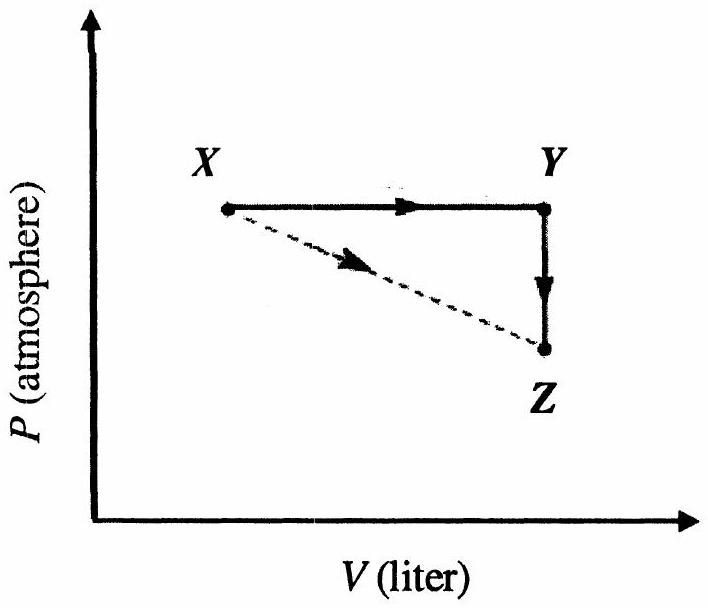
For an ideal gas, consider only P−V work in going from an initial state X to the final state Z. The final state Z can be reached by either of the two paths shown in the figure. Which of the following choice(s) is (are) correct ? [take ΔS as change in entropy and w as work done]
(A)ΔSx→z=ΔSx→y+ΔSy→z✓ Correct
(B)wx→z=wx→y+wy→z
(C)wx→y→z=wx→y✓ Correct
(D)ΔSx→y→z=ΔSx→y
Answer: (A), (C)
Solution
(A) Entropy (S) is a state function, so its change depends only on initial and final states, not on the path. Therefore, ΔSX→Z=ΔSX→Y+ΔSY→Z is correct.
(B) Work (w) is a path function, not a state function. The work done along the direct path X→Z is generally different from the sum wX→Y+wY→Z. This is incorrect.
(C) From the diagram, Y→Z is an isochoric (constant volume) process, so wY→Z=0. Therefore, wX→Y→Z=wX→Y+0=wX→Y. This is correct.
(D) Since entropy is a state function and Z ≠ Y, ΔSX→Y→Z=ΔSX→Y. This is incorrect.
JEE Advanced · 2012 · 08 Apr 2012 · Paper 1 · One or more correct options