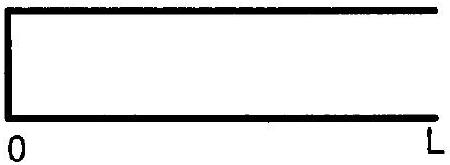
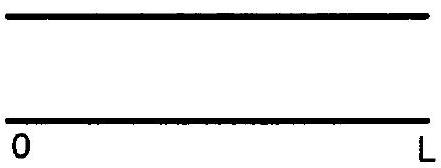
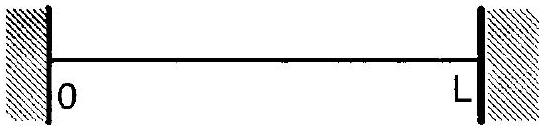
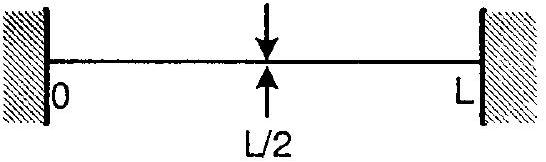
Column I shows four systems, each of the same length L, for producing standing waves. The lowest possible natural frequency of a system is called its fundamental frequency, whose wavelength is denoted as λf. Match each system with statements given in Column II describing the nature and wavelength of the standing waves.
Column I (A) Pipe closed at one end (see structure) (B) Pipe open at both ends (see structure) (C) Stretched wire clamped at both ends (see structure) (D) Stretched wire clamped at both ends and at mid-point (see structure)
Column II (p) Longitudinal waves (q) Transverse waves (r) λf=L (s) λf=2L (t) λf=4LABCD
Answer: A → I, A → V, B → I, B → IV, C → II, C → IV, D → II, D → III
Solution
(A) Pipe closed at one end: sound waves (longitudinal), fundamental has L = λ/4, so λ_f = 4L. (B) Pipe open at both ends: sound waves (longitudinal), fundamental has L = λ/2, so λ_f = 2L. (C) Stretched wire clamped at both ends: transverse waves, fundamental has L = λ/2, so λ_f = 2L. (D) Wire clamped at both ends and mid-point: transverse waves, fundamental mode with mid-point node has L = λ, so λ_f = L.
JEE Advanced · 2011 · 10 Apr 2011 · Paper 2 · Match the columns