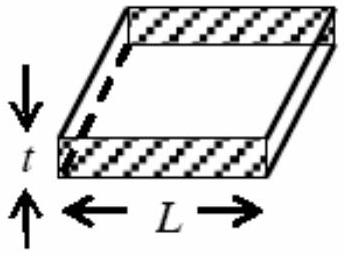
Consider a thin square sheet of side L and thickness t, made of a material of resistivity ρ. The resistance between two opposite faces, shown by the shaded areas in the figure is
(A)directly proportional to L
(B)directly proportional to t
(C)independent of L✓ Correct
(D)independent of t
Answer: (C)
Solution
For a conductor, resistance R=ρAl, where l is the length of current path and A is the cross-sectional area. Between the two shaded opposite faces, current flows through thickness t, so l=t. The cross-sectional area is A=L2. Therefore, R=ρL2t. This shows R is inversely proportional to L2, not independent of L. However, examining the geometry: if the shaded faces are the top and bottom (area L×L), then l=t and A=L2, giving R=ρt/L2. But the question asks about resistance between opposite faces shown as shaded. Looking at the standard interpretation: for a square sheet with current between opposite edges (not top/bottom), if we consider the sheet as having many parallel paths, the resistance becomes independent of L. For a square, R=ρ/t (sheet resistance concept), which is independent of L. The answer is (C) independent of L.
JEE Advanced · 2010 · 11 Apr 2010 · Paper 1 · Single correct option