In which of the following complexes the CFSE, Δ0 will be equal to zero?
(A)[Fe(NH3)6]Br2
(B)[Fe(en)3]Cl3
(C)K4[Fe(CN)6]
(D)K3[Fe(SCN)6]✓ Correct
Answer: (D)
Solution
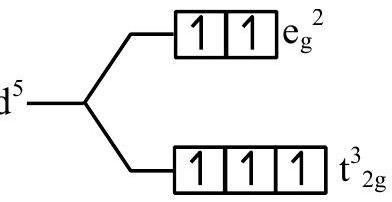
CFSE depends on how the d-electrons are distributed between the t2g and eg sets in an octahedral field. In K3[Fe(SCN)6], iron is Fe3+ (d5), and SCN− is a weak-field ligand, so the complex is high spin with configuration t2g3eg2:
CFSE=(−0.4×3+0.6×2)Δ0=(−1.2+1.2)Δ0=0
The half-filled high-spin d5 arrangement puts three electrons in t2g and two in eg, exactly cancelling any net stabilization.
In [Fe(NH3)6]Br2 and K4[Fe(CN)6], iron is Fe2+ (d6); NH3 gives a high-spin t2g4eg2 arrangement (CFSE =−0.4Δ0) while the strong-field CN− forces low spin, t2g6 (CFSE =−2.4Δ0). In [Fe(en)3]Cl3, Fe3+ with the strong-field chelate en is low spin, t2g5 (CFSE =−2.0Δ0). Only the high-spin d5 thiocyanate complex gives zero net CFSE.
JEE Main · 2025 · 22 Jan 2025 · Shift 1 · Single correct option