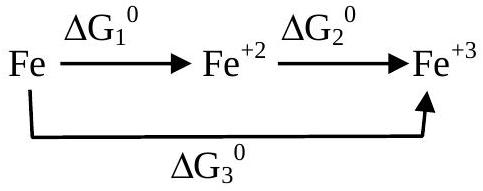
For the given cell Fe2+(eq)+Ag+(aq)→Fe3+(aq)+Ag(s) The standard cell potential of the above reaction is Given : Ag++e−→Ag E0=xV Fe2++2e−→Fe E0=yV Fe3++3e−→Fe E0=zV
(A)x+y−z
(B)x+2y−3z✓ Correct
(C)y−2x
(D)x+2y
Answer: (B)
Solution
Electrode potentials cannot be added or subtracted directly across half-reactions with different numbers of electrons — their free energies (ΔG∘=−nFE∘) must be combined instead.
Fe3++3e−→Fe,ΔG3∘=−3Fz Fe2++2e−→Fe,ΔG1∘=−2Fy
Subtracting the second from the first gives the desired one-electron couple, Fe3++e−→Fe2+: ΔG∘=ΔG3∘−ΔG1∘=−3Fz−(−2Fy)=2Fy−3Fz
Since this is a one-electron step, ΔG∘=−F⋅EFe3+/Fe2+∘, so EFe3+/Fe2+∘=3z−2y
For the overall cell reaction Fe2++Ag+→Fe3++Ag, Ag+ is reduced at the cathode (E∘=x) while Fe2+ is oxidised to Fe3+ at the anode — the reverse of the couple just found: Ecell∘=Ecathode∘−Eanode∘=x−(3z−2y)=x+2y−3z
JEE Main · 2025 · 24 Jan 2025 · Shift 1 · Single correct option