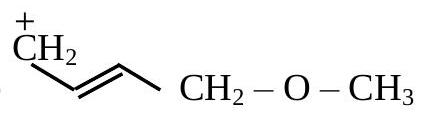
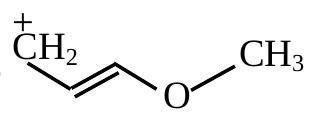
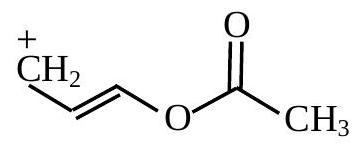
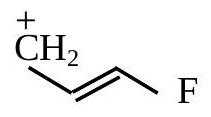
Which one of the carbocations from the following is most stable?
(A)(see structure)
(B)(see structure)✓ Correct
(C)(see structure)
(D)(see structure)
Answer: (B)
Solution
Carbocation stability rises with any effect that delocalises the positive charge: resonance (+M) donation is generally the strongest stabilising influence, followed by inductive (+I) donation and hyperconjugation, while electron-withdrawing groups destabilise a cation.
In the allylic carbocation bearing a −OCH3 group directly conjugated with the cationic system, the oxygen lone pair delocalises into the adjacent empty p-orbital through the conjugated π system, spreading the positive charge onto oxygen as well as carbon (an oxocarbenium-type resonance contributor). This +M stabilisation is stronger than what is available in the other cations: an ether oxygen not held in direct conjugation, an ester carbonyl oxygen whose lone pair is tied up in conjugation with its own carbonyl rather than free to donate into the cation, and a fluorine substituent whose inductive electron withdrawal actually destabilises the adjacent positive charge.
The carbocation conjugated through the allylic system with the −OCH3 group is the most stable.
JEE Main · 2025 · 24 Jan 2025 · Shift 1 · Single correct option