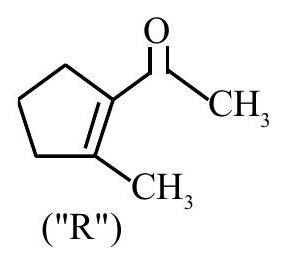
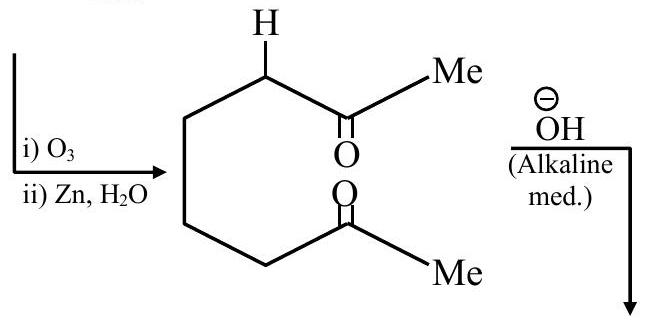
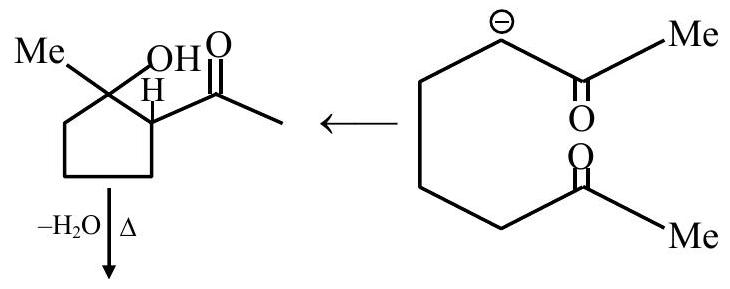
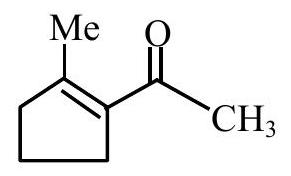
A molecule ("P") on treatment with acid undergoes rearrangement and gives ("Q") ("Q") on ozonolysis followed by reflux under alkaline condition gives (" R "). The structure of (" R ") is given below : (see structure)
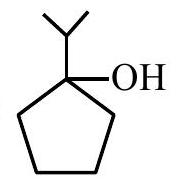
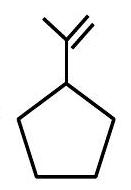
The structure of (" P ") is
(A)(see structure)
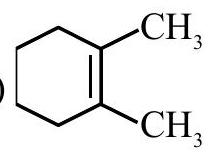
(B)(see structure)✓ Correct
(C)(see structure)
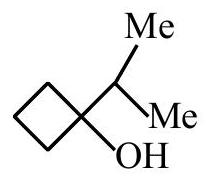
(D)(see structure)
Answer: (B)
Solution
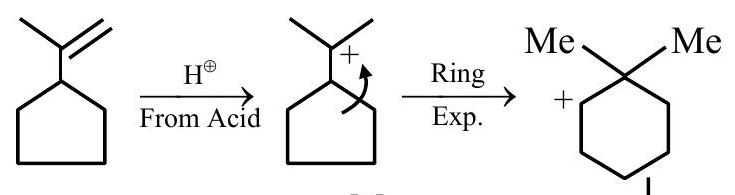
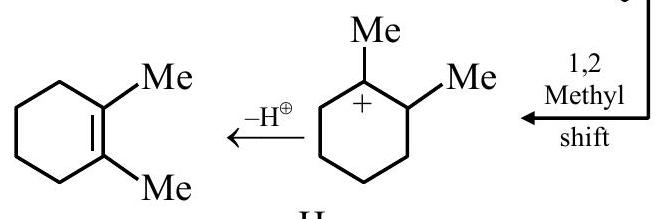
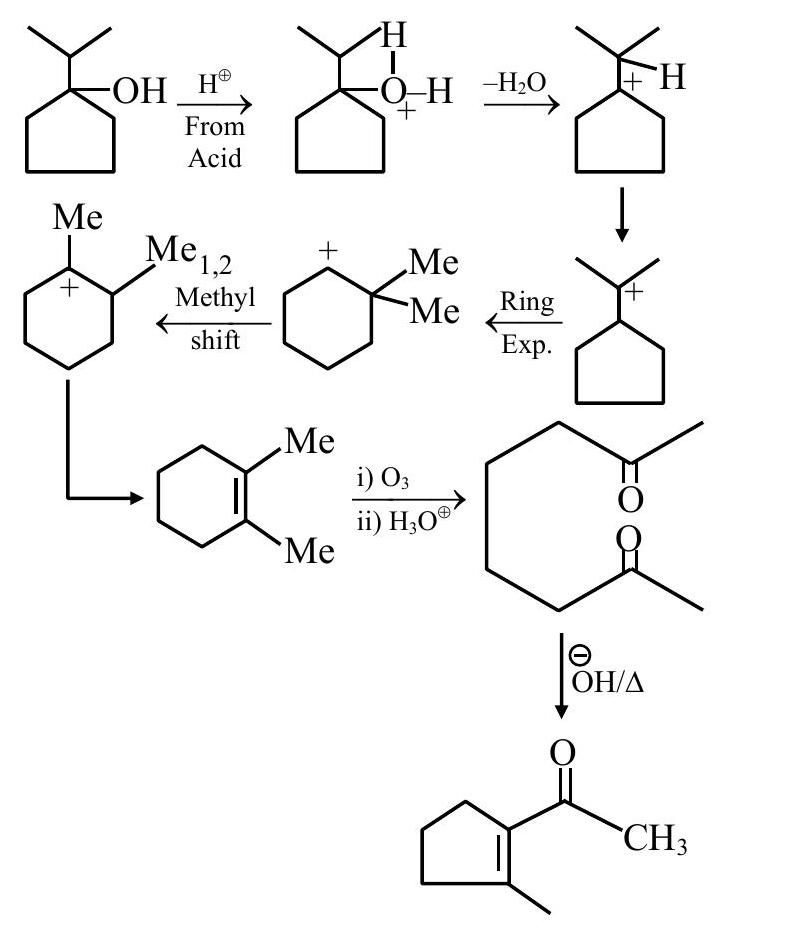
Acid protonates the tertiary carbinol carbon of the starting cyclopentane derivative and water leaves, generating a tertiary carbocation on the ring; relief of ring strain drives a 1,2-alkyl (ring C–C bond) shift that expands the five-membered ring to a six-membered one, placing the positive charge on a new tertiary centre carrying two methyl groups. A further 1,2-methyl shift and loss of a proton then gives a trisubstituted cyclohexene bearing a gem-dimethyl group on the carbon next to the double bond — this rearranged alkene is Q. Ozonolysis of Q cleaves the ring double bond to a keto-aldehyde chain, and refluxing this dicarbonyl compound under alkaline conditions triggers an intramolecular aldol condensation with loss of water, closing a five-membered ring and delivering the cyclopentenyl methyl ketone shown as R. Running this sequence backward from R fixes the identity of P as 1-cyclopentyl-1-methylethan-1-ol (2-cyclopentylpropan-2-ol): acid-catalysed ionisation of this tertiary alcohol generates exactly the rearranging cation described above.
JEE Main · 2025 · 28 Jan 2025 · Shift 1 · Single correct option