JEE Main · 2025 · 29 Jan 2025 · Shift 1 · Redox Reactions and Electrochemistry

WhatsApp Email
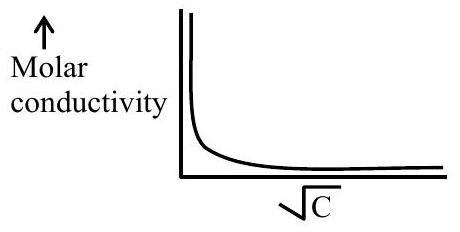
The molar conductivity of a weak electrolyte when plotted against the square root of its concentration, which of the following is expected to be observed?
  1. (A)A small decrease in molar conductivity is observed at infinite dilution.
  2. (B)A small increase in molar conductivity is observed at infinite dilution.
  3. (C)Molar conductivity increases sharply with increase in concentration.
  4. (D)Molar conductivity decreases sharply with increase in concentration.✓ Correct

Answer: (D)

Solution

For a weak electrolyte, molar conductivity tracks the degree of dissociation through . As concentration rises, the dissociation equilibrium is pushed back and falls off steeply (Ostwald's dilution law gives in the weak-dissociation limit). Plotted against , this produces a curve that drops sharply as concentration increases, quite unlike the gentle, near-linear fall shown by strong electrolytes. Molar conductivity therefore decreases sharply with increasing concentration.

JEE Main · 2025 · 29 Jan 2025 · Shift 1 · Single correct option
More JEE Main questions on Redox Reactions and Electrochemistry

  1. The pH and conductance of a weak acid (HX) was found to be 5 and , respectively. The conductance was measured under standard condition using a cell where the electrode plates having a surface area of were at a distance of 15 cm a …
    JEE Main 2026View solution →
  2. Consider the following electrochemical cell at 298 K
    .
    If the reaction quotient at a giv …
    JEE Main 2026View solution →
  3. Aqueous HCl reacts with to form , and . What is the weight (in g) of liberated when 8.7 g of is reacted w …
    JEE Main 2026View solution →
  4. For a closed circuit Daniell cell, which of the following plots is the accurate one at a given temperature?
    JEE Main 2026View solution →
  5. MX is a sparingly soluble salt that follows the given solubility equilibrium at 298 K
    ;
    If the standard reduction potential for …
    JEE Main 2026View solution →
  6. Consider the following reduction processes:

    …
    JEE Main 2026View solution →