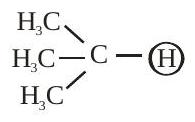
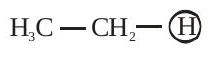
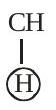
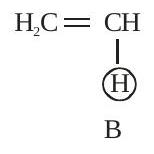
The ascending acidity order of the following H atoms isCDAB
(A)C < D < B < A✓ Correct
(B)A < B < C < D
(C)A < B < D < C
(D)D < C < B < A
Answer: (A)
Solution
Acidity of a C–H bond tracks the stability of the carbanion left behind on deprotonation, which in turn tracks the s-character of the hybrid orbital holding the negative charge — greater s-character holds the lone pair closer to the nucleus and is more stable.
A is a terminal alkyne C–H: the conjugate base is sp-hybridised (50% s-character), the most stable and most acidic of the four.
B is a vinylic C–H: the conjugate base is sp2-hybridised (33% s-character).
D is an allylic C–H: the conjugate base is sp3-hybridised, but the negative charge is delocalised by resonance into the adjacent double bond, giving it more stability than an isolated sp3 carbanion.
C is a simple alkane C–H: the conjugate base is sp3-hybridised with no resonance stabilisation available, making it the least stable and least acidic.
Ranking by increasing acidity: C < D < B < A.
JEE Main · 2024 · 29 Jan 2024 · Shift 2 · Single correct option