Which one of the following will show geometrical isomerism?
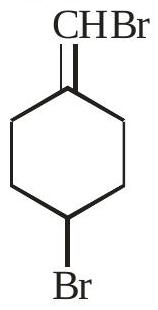
(A)(see structure)
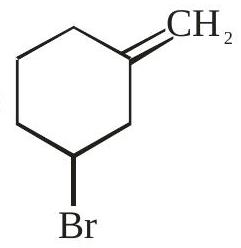
(B)(see structure)
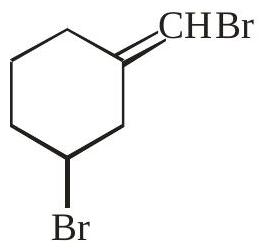
(C)(see structure)✓ Correct
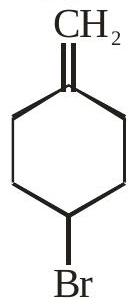
(D)(see structure)
Answer: (C)
Solution
For a carbon–carbon double bond to show cis–trans (geometrical) isomerism, each of the two doubly-bonded carbons must carry two different groups.
In the correct structure, an exocyclic =CHBr group is attached to the ring, with a bromine also present on the ring at a position that removes the symmetry of the ring. The exocyclic alkene carbon bears H and Br (two different groups), and the ring carbon of the double bond is flanked by two non-equivalent ring arms because of that additional, unsymmetrically placed bromine. Both conditions for geometrical isomerism are met, so distinct cis and trans forms exist.
In the remaining structures, the exocyclic alkene carbon carries two identical hydrogens (a terminal =CH2 group), or the substitution pattern restores a plane of symmetry across the ring — either way, no cis–trans pair is possible.
Only the structure with the unsymmetrically substituted alkylidenecyclohexane shows geometrical isomerism.
JEE Main · 2024 · 29 Jan 2024 · Shift 2 · Single correct option