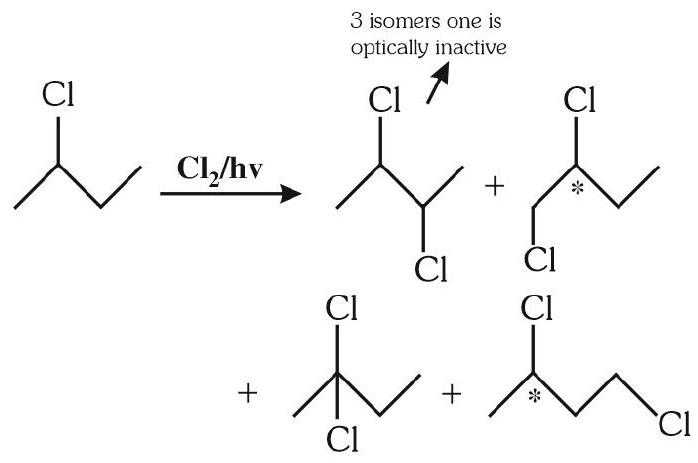
2-chlorobutane +Cl2→C4H8Cl2 (isomers) Total number of optically active isomers shown by C4H8Cl2, obtained in the above reaction is ____.
Answer: 6
Solution
Free-radical chlorination of 2-chlorobutane, CH3–CHCl–CH2–CH3, can substitute at any of its four carbons. Substitution at C-1 gives 1,2-dichlorobutane, with a single stereocentre at C-2 (bonded to Cl, CH2Cl, C2H5, H) — a chiral pair of enantiomers, both optically active. Substitution at C-2 (the carbon already bearing Cl) gives 2,2-dichlorobutane, with two identical chlorines on that carbon, so it has no stereocentre and is achiral. Substitution at C-3 gives 2,3-dichlorobutane, which now carries two stereocentres with an identical set of substituents on each — this gives a chiral (R,R)/(S,S) enantiomeric pair (both optically active) and a separate achiral meso (R,S) form. Substitution at C-4 gives 1,3-dichlorobutane, CH3–CHCl–CH2–CH2Cl, whose remaining stereocentre (Cl, CH3, H, CH2CH2Cl, all different) again gives a chiral pair, both optically active. Counting the optically active members: 2 (from C-1) + 2 (the d,l pair from C-3) + 2 (from C-4) = 6.
JEE Main · 2024 · 30 Jan 2024 · Shift 2 · Integer answer