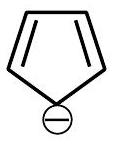
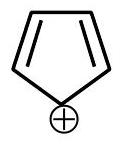
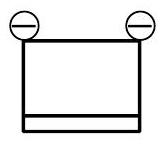
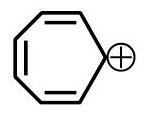
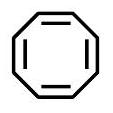
Designate whether each of the following compounds is aromatic or not aromatic. (a) (see structure) (b) (see structure) (c) (see structure) (d) (see structure) (e) (see structure) (f) (see structure) (g) (see structure) (h) (see structure)abcdefgh
(A)e, g aromatic and a, b, c, d, f, h not aromatic
(B)b, e, f, g aromatic and a, c, d, h not aromatic
(C)a, b, c, d aromatic and e, f, g, h not aromatic
(D)a, c, d, e, h aromatic and b, f, g not aromatic✓ Correct
Answer: (D)
Solution
Aromaticity demands a planar, fully conjugated ring holding (4n+2)π electrons. The cyclopentadienyl anion (six π electrons), the cyclobutadienyl dication (two), the cyclobutadienyl dianion (six), the tropylium cation (six) and the cyclopropenyl cation (two) each meet this count and are aromatic. The cyclopentadienyl cation and neutral cyclobutadiene each carry four π electrons, and cyclooctatetraene with eight π electrons puckers out of plane, so these three are not aromatic. The aromatic species are thus the cyclopentadienyl anion, the cyclobutadienyl dication, the cyclobutadienyl dianion, the tropylium cation and the cyclopropenyl cation, the remaining three being non-aromatic.
JEE Main · 2025 · 02 Apr 2025 · Shift 1 · Single correct option