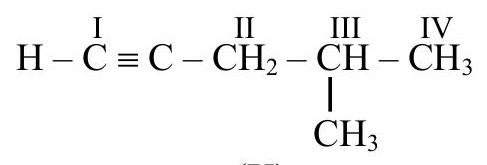
The most stable and least stable carbon radicals, respectively, produced by homolytic cleavage of corresponding C−H bond are :
(A)II, IV
(B)III, II
(C)I, IV
(D)II, I✓ Correct
Answer: (D)
Solution
In the carbon chain HC≡C−CHX2−CH(CHX3)CHX3, removing a hydrogen from the propargylic CHX2 at position II gives a radical whose unpaired electron is delocalised onto the neighbouring triple bond, making it the most stabilised of the four. Removing the hydrogen from the terminal ≡C−H at position I leaves the electron on an sp-hybridised carbon; the high s-character binds it tightly and no delocalisation is available, so this radical is the least stable. The most stable radical thus forms at the propargylic carbon and the least stable at the terminal alkyne carbon.
JEE Main · 2025 · 02 Apr 2025 · Shift 1 · Single correct option