JEE Main · 2025 · 02 Apr 2025 · Shift 2 · Chemical Bonding and Molecular Structure

WhatsApp Email
Which among the following molecules is (a) involved in hybridization, (b) has different bond lengths and (c) has lone pair of electrons on the central atom ?
  1. (A)
  2. (B)
  3. (C)✓ Correct
  4. (D)

Answer: (C)

Solution

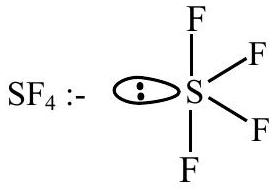
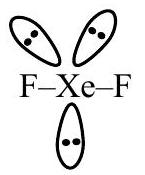
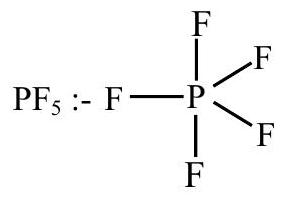
The molecule required must use one d orbital in bonding (), carry a lone pair on the central atom, and therefore have geometrically inequivalent bonds. is but has no lone pair on phosphorus. is and square planar. is with three lone pairs but is linear with two identical bonds. is with one lone pair on sulphur, giving a see-saw shape in which the two axial S–F bonds are longer than the two equatorial S–F bonds. The species that is hybridised, has unequal bond lengths and bears a lone pair on the central atom is sulphur tetrafluoride.

JEE Main · 2025 · 02 Apr 2025 · Shift 2 · Single correct option
More JEE Main questions on Chemical Bonding and Molecular Structure

  1. Given below are two statements:

    Statement I: The number of species among , , , , , and , that have tetrahedral geometry …
    JEE Main 2026View solution →
  2. The formal changes on the atoms marked as (1) to (4) in the Lewis representation of molecule respectively are
    JEE Main 2026View solution →
  3. The correct increasing order of , , and bonds in terms of covalent bond length is:
    JEE Main 2026View solution →
  4. Among and , identify the molecule with lowest dipole moment value. The number of lone pairs of electrons present on the central atom of the molecule …
    JEE Main 2026View solution →
  5. Identify the molecule with maximum number of lone pairs of electrons (obtained using Lewis dot structure) among , , and . Choose the correct bond angle made by the central atom of the molecule (X).
    JEE Main 2026View solution →
  6. Given below are statements about some molecules/ions.

    Identify the CORRECT statements.
    A. The dipole moment value of is higher than that of .
    B. The dipole moment value of is zero.
    C. The bond order of …
    JEE Main 2026View solution →