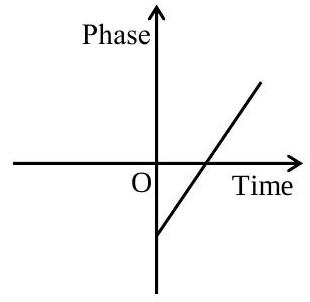
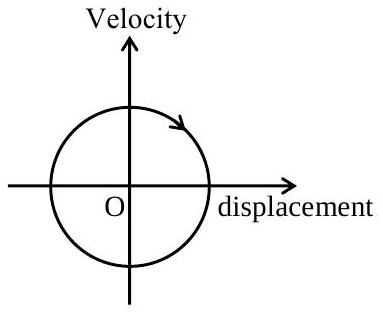
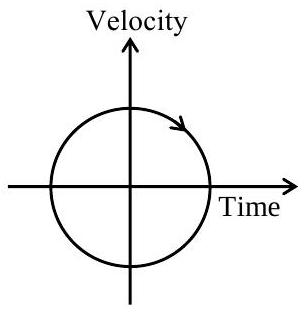
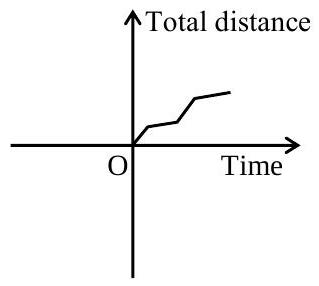
Which of the following curves possibly represent one-dimensional motion of a particle ? (A) (see graph) (B) (see graph) (C) (see graph) (D) (see graph)
Choose the correct answer from the options given below :ABCD
(A)A, B and D only✓ Correct
(B)A, B and C only
(C)A and B only
(D)A, C and D only
Answer: (A)
Solution
A graph can describe one-dimensional motion only if each instant gives a single value of the plotted quantity and no impossible value, such as negative time, appears. The straight line of phase against time is single-valued and admissible, for instance the phase of simple harmonic motion, so the first graph is possible. The closed curve of velocity against displacement, v2+x2=constant, is exactly the phase path of simple harmonic motion, so the second graph is possible. The ever-rising staircase of total distance against time is admissible because total distance never decreases, so the fourth graph is possible. The closed curve of velocity against time would assign two velocities to one instant and reaches negative time, which cannot happen, so the third graph is impossible. The graphs that can represent one-dimensional motion are the first, the second and the fourth.
JEE Main · 2025 · 03 Apr 2025 · Shift 1 · Single correct option