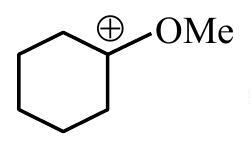
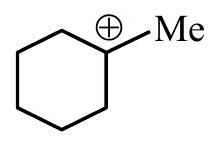
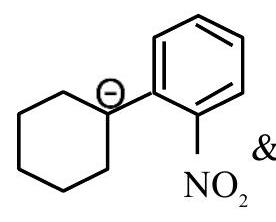
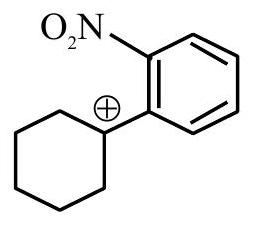
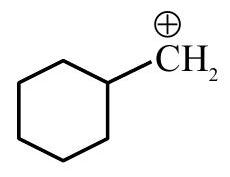
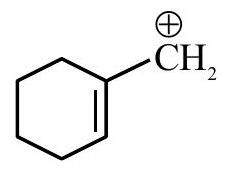
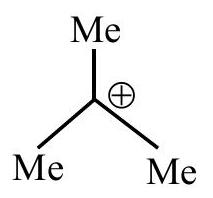
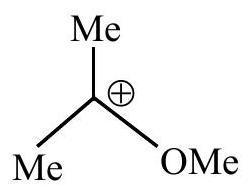
In which pairs, the first ion is more stable than the second? (A) & (B) & (C) & (D) &A-firstA-secondB-firstB-secondC-firstC-secondD-firstD-second
(A)(B) & (D) only
(B)(A) & (B) only✓ Correct
(C)(B) & (C) only
(D)(A) & (C) only
Answer: (B)
Solution
In the first pair the cation that carries a methoxy group directly on the positive carbon is stabilised by donation of an oxygen lone pair, which spreads the charge onto oxygen to give an oxocarbenium ion; this outweighs the hyperconjugative stabilisation of the simple tertiary methyl-substituted cation, so the first ion is the more stable. In the second pair the species bearing the negative charge next to an o-nitrophenyl group is stabilised because the electron-withdrawing nitro group disperses that negative charge, while the corresponding cation is destabilised by the same electron withdrawal, so once more the first ion is the more stable. In the third pair the second species is an allylic cation whose charge is shared over two carbons and so is more stable than the first, a localised primary cation, so here the first is not the more stable. In the fourth pair the second species, bearing an adjacent methoxy group, is an oxocarbenium ion more stable than the first tertiary cation, so again the first is not the more stable. The first ion is more stable only in the first and second pairs.
JEE Main · 2025 · 04 Apr 2025 · Shift 2 · Single correct option