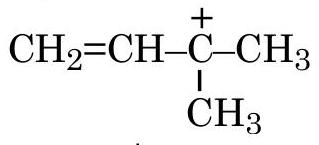
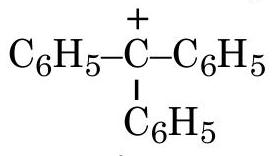
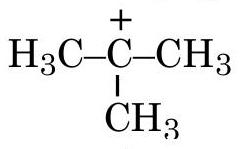
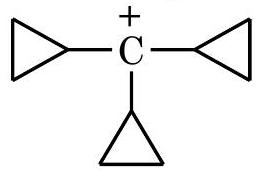
The decreasing order of hydride affinity for following carbocations is: A. (see structure) B. (see structure) C. (see structure) D. (see structure) Choose the correct answer from the options given below:ABCD
(A)A, C, B, D
(B)C, A, B, D✓ Correct
(C)C, A, D, B
(D)A, C, D, B
Answer: (B)
Solution
Hydride affinity is the tendency of a carbocation to accept a hydride, so it is highest for the least stable cation. The tert-butyl cation (CH3)3C+ is stabilised only by hyperconjugation, so it is the least stable and has the greatest hydride affinity. The allylic tertiary cation CH2=CH−C+(CH3)2 gains additional allylic resonance, lowering its hydride affinity. The triphenylmethyl cation is stabilised by three phenyl rings, and the tricyclopropylmethyl cation is stabilised even more strongly by three cyclopropyl rings, making it the most stable and the poorest hydride acceptor. The decreasing order of hydride affinity is tert-butyl > allylic dimethyl > triphenylmethyl > tricyclopropylmethyl.
JEE Main · 2023 · 10 Apr 2023 · Shift 2 · Single correct option