JoSAA — the Joint Seat Allocation Authority — is the body that conducts the centralised counselling for admission to the IITs, NITs, IIITs, and GFTIs. By the time a student finishes JEE Main and (where applicable) JEE Advanced, they've done the hard part. JoSAA is where the result becomes a seat.
This article walks through how JoSAA works: the timeline, what choice filling really means, the rounds, the freeze-slide-float decision, and the small set of mistakes that families often make in the rush of those weeks.
It's a long article because counselling itself is dense, and we'd rather you have the whole picture in one place than have to switch between five tabs. We've put a table of contents on the right (on desktop) so you can navigate.
Note: This article is written to be evergreen, but specific dates, fees, eligibility thresholds, and procedural details are set each year by the relevant authority — NTA, JoSAA, BITS Pilani, HSTES, or the institute concerned. Always cross-check the latest official notification before acting on anything time-sensitive.
What JoSAA does
Imagine the situation in early June. A few lakh students have written JEE Main. Around 2.5 lakh have qualified for JEE Advanced. Both ranks have been declared. There are a fixed number of seats at IITs, NITs, IIITs, and GFTIs — totalling roughly 55,000 across all categories and all institutes.
The question is: which student gets which seat?
JoSAA is the answer. Through a single, centralised process, every eligible student lists the colleges and branches they want — in order of preference — and the system allocates seats over several rounds based on rank and choice.
The institutes participating in JoSAA each year:
- 23 IITs — allocated through JEE Advanced ranks.
- 31 NITs — allocated through JEE Main ranks.
- ~25 IIITs — allocated through JEE Main ranks.
- ~30+ GFTIs (Government-Funded Technical Institutes — institutions like ISM Dhanbad before it became an IIT, the various IIEST/Bengal Engineering institutions, SLIET, etc.) — allocated through JEE Main ranks.
A few institutes choose not to participate in JoSAA in some years and run their own admission. The current list of participating institutes is on the JoSAA website each year.
Who participates in JoSAA
Two groups of students:
- Students with a valid JEE Advanced rank can apply for IIT, NIT, IIIT, and GFTI seats — essentially every seat in JoSAA.
- Students with only a JEE Main rank (no Advanced rank) can apply for NIT, IIIT, and GFTI seats — not IIT seats.
Both groups use the same JoSAA portal. There's no separate registration for the two streams.
Registration
JoSAA registration opens shortly after the JEE Advanced result is declared. The window stays open through the first few rounds — there's no separate "registration deadline" that locks you out after Round 1.
Registration itself is short: you log in with your JEE Main credentials, verify your details, and confirm category and any special quotas. Most of the time spent on the portal will be in the choice filling step, not registration.
Choice filling — the most important step
Choice filling is where you tell JoSAA: these are the colleges and branches I want, in this order of preference. It's the heart of the process.
A few principles worth absorbing carefully:
Fill many choices, not few
JoSAA lets you list a hundred or more choices. Use that fully. A short list saves no time and risks getting no seat at all. If your rank doesn't reach any of your listed choices, you get no allotment in that round — even if you had the rank for seats you didn't list.
A reasonable list often looks like:
- A few aspirational choices at the top (colleges and branches above your rank zone — you want to be allotted them in the event of an unusually favourable round).
- A larger middle band of realistic choices around your rank zone.
- A solid safety band at the bottom of choices you'd be content to study at.
The middle band is where most seats get allotted. The aspirational and safety bands matter at the edges of the round.
Order by what you actually want, not what you think you'll get
This is the principle most students get wrong, often pushed by well-meaning relatives:
"Don't put IIT Bombay CSE at the top, you'll never get it."
That's the wrong logic. Putting IIT Bombay CSE at the top doesn't reduce your chance of getting any seat — JoSAA looks down your list from your top choice and stops at the first one your rank reaches. If you can't get the top one, it tries the next, and so on. The only effect of putting your dream choice high is that if the round goes well, you get it.
The right ordering is: rank by genuine preference, in the order you'd actually want them. Then trust the algorithm.
Branch versus brand
This is the recurring counselling debate: a CS seat at a slightly less-prestigious institute, or a Mechanical seat at a top one. There's no universal answer. Some practical observations:
- For most students, having a clear sense of what they want to do matters more than the institute's brand. A student who's enthusiastic about CS at NIT Surathkal will likely have a better four years than the same student forced into Civil at IIT (Roorkee) just because IIT.
- That said, brand does affect early-career opportunities — placements, exposure, peer group. The effect is real but not absolute.
- Talk to seniors at both kinds of institutes (a chat over a coffee will give you more than ten online lists). Talk to recent graduates about how they actually use their training.
We have a longer article on this question — JEE Main vs JEE Advanced: What's the Real Difference covers some of it, and we'll write a dedicated piece on branch-vs-brand next. For counselling itself, the practical advice is: come into the choice-filling step with this decision already made. Don't try to decide between branch and brand during the 24 hours before locking.
Lock your choices
Once you've filled and ordered your choices, you lock them. This finalises your list for the round. Unlocked choices are not considered. Many students lose hours on the last day of the window because they forgot this step.
The rounds
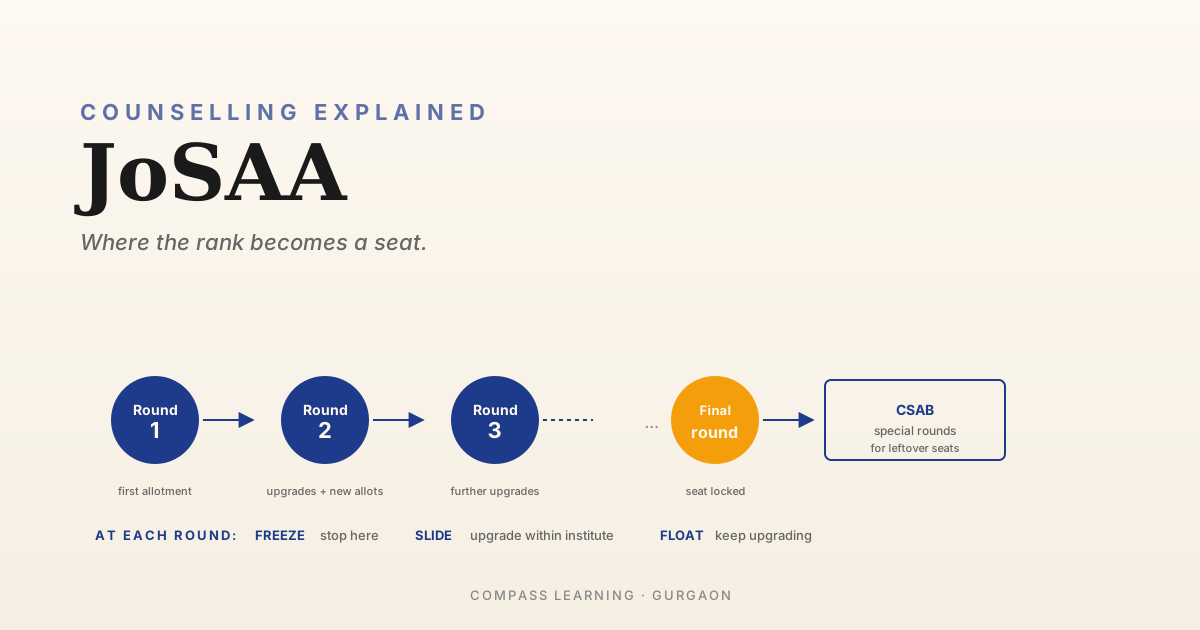
JoSAA runs in several rounds — typically five to six, conducted across about four weeks. The total number of rounds is announced at the start of each year's counselling.
Here's what happens in each round:
- Allotment. Based on every registered student's locked choices and rank, the system assigns one seat (or no seat) to each student.
- Decision. If you got a seat, you have three options (covered in detail below): Freeze, Slide, Float.
- Fee payment and document upload. If you accepted (in any of the three ways), you pay a seat acceptance fee and upload required documents.
- Next round. The unfilled and newly vacated seats go back into the pool for the next round.
If you didn't get a seat in a round, you stay in the pool with the same locked choices and try again in the next round.
Freeze, Slide, Float
When you get an allotment, you choose what to do with it. This is the single most-misunderstood mechanic in counselling. Take it slowly:
Freeze. You accept the allotted seat and withdraw from further rounds. You're done. No matter what happens in later rounds, you'll be admitted to this seat. Pick Freeze when you're happy with what you got and don't want to risk anything different.
Float. You accept the allotted seat as a backup, but stay in consideration for any choice ranked higher than the current allotment on your list. If a higher-ranked choice opens up in a later round, you'll get upgraded. If nothing higher opens, you keep what you have.
Slide. Similar to Float, but restricted to upgrades within the same institute. You'll only get upgraded to a higher-ranked choice if it's in the same institute as your current allotment. Useful for students who like the institute but want a better branch within it.
In simpler terms:
- Freeze = "I'm happy, stop."
- Slide = "Try to upgrade my branch within this institute."
- Float = "Try to upgrade my college or branch."
A common pattern: choose Float through the early rounds (to keep upgrading), and Freeze in a later round once you've reached something you're happy with.
Important: even with Float or Slide, you've paid the seat acceptance fee and you have a confirmed seat. You're not gambling — you're upgrading from a known floor.
Document verification and reporting
After your final allotment (whether you froze it or it was your last upgrade), there's a document verification step. Originally this was an in-person reporting at the allotted institute or a designated reporting centre. In recent years, much of this has moved online — you upload documents, they get verified, and you may or may not need to physically report to the institute before the academic session starts.
Documents typically needed: Class X & XII marksheets, JEE Main and Advanced scorecards, category certificate (if applicable), date of birth proof, photo ID, passport-size photos, the seat acceptance receipt. The exact list is on JoSAA's website each year.
Withdrawal
If at any point you decide you don't want any JoSAA seat — say, because you've decided to take admission at a private university instead — you can withdraw from JoSAA. There's a deadline for withdrawal each year, after which the seat is locked.
Withdrawal refunds most of your seat acceptance fee, minus a small administrative charge.
CSAB Special Rounds
After JoSAA completes its rounds, some seats remain — either because no one took them, or because someone withdrew late, or because of small last-minute changes. These leftover seats go into CSAB Special Rounds, conducted by the Central Seat Allocation Board.
CSAB is essentially a second-chance round for NIT, IIIT, and GFTI seats (not IITs). It has its own registration and its own choice filling. Students who didn't get a seat in JoSAA, or who got one but want to try for something else, can register.
We'll write a dedicated article on CSAB — CSAB Special Rounds: Who Gets a Second Chance — covering its mechanics in detail.
Common mistakes
Patterns we've seen, recurring year after year:
- Filling too few choices. Twenty isn't enough. Use closer to a hundred.
- Ordering by perceived chance instead of preference. As covered above.
- Forgetting to lock. Choices not locked aren't counted.
- Confusing Freeze with Float. A student who meant Float clicks Freeze and gets locked out of further rounds.
- Missing the document verification deadline. Allotment without verification is incomplete.
- Not paying the seat acceptance fee on time. The seat lapses.
- Withdrawing too early. Sometimes families withdraw from JoSAA on the basis of a private admission, only to discover the private admission has its own complications. Withdraw only when the alternative is fully confirmed.
Almost all of these come from haste. Counselling is conducted in compressed weeks, often while a family is also navigating private university admissions, hostel decisions, and travel logistics. The discipline is to sit with each round for an hour with a calm head before clicking anything irreversible.
Where to read next
For the bigger picture: The Engineering Admissions Roadmap.
For the exam side: JEE Main: A Complete Guide and JEE Advanced: A Complete Guide.
For the leftover-seats round: CSAB Special Rounds: Who Gets a Second Chance (coming soon).
For understanding ranks and cutoffs: Understanding Cutoffs and Closing Ranks.
Have questions about your specific situation?
We're at Ardee City, Sector 52, Gurgaon. Drop by anytime, or give us a call. Always happy to chat through strategy with parents and students — no pitch, no pressure, just a conversation about what makes sense for you.