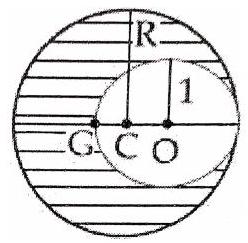
As shown in figure when a spherical cavity (centered at O) of radius 1 is cut out of a uniform sphere of radius R (centred at C ), the centre of mass of remaining (shaded) part of sphere is at G, i.e. on the surface of the cavity. R can be determined by the equation:
(A)(R2+R+1)(2−R)=1
(B)(R2+R−1)(2−R)=1✓ Correct
(C)(R2−R+1)(2−R)=1
(D)(R2−R−1)(2−R)=1
Answer: (B)
Solution
Treat the shaded body as the full sphere with a sphere of negative mass filling the cavity. With uniform density the full sphere of radius R acts like a mass proportional to R3 at its centre C, and the cavity of radius 1 like a mass proportional to 13 at its own centre, a distance (R−1) from C. The centre of mass of what remains lies on the line of the two centres at a distance R3−1R−1 from C, and the problem fixes that point on the surface of the cavity, a distance (2−R) from C. Equating, R3−1R−1=2−R, and since R3−1=(R−1)(R2+R+1) the factor (R−1) cancels to leave R2+R+11=2−R, that is (R2+R+1)(2−R)=1.
JEE Main · 2020 · 08 Jan 2020 · Shift 2 · Single correct option