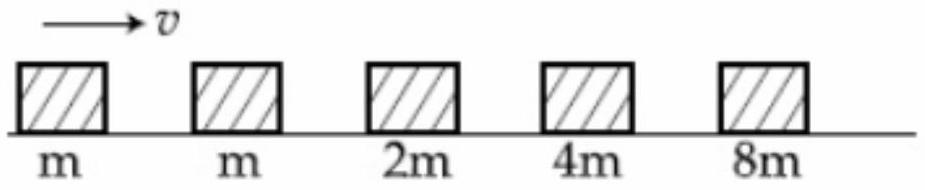
Blocks of masses m, 2m, 4m and 8m are arranged in a line on a frictionless floor. Another block of mass m, moving with speed v along the same line (see figure) collides with mass m in perfectly inelastic manner. All the subsequent collisions are also perfectly inelastic. By the time the last block of mass 8m starts moving the total energy loss is p% of the original energy. Value of 'p' is close to:
(A)77
(B)37
(C)87
(D)94✓ Correct
Answer: (D)
Solution
In a perfectly inelastic collision the moving mass sticks to the one it strikes, and momentum is conserved throughout. The incident block of mass m at speed v carries momentum mv, and this momentum is handed on unchanged through the whole chain of sticking collisions. By the time the heaviest block has been set moving, the incident block has merged successively with the line of stationary blocks and the whole assembly moves together with combined mass 16m, so its common speed is vf=16mmv=16v. The kinetic energy left in the system is 21(16m)(16v)2=161(21mv2), only 161 of the original 21mv2. The fraction of energy lost is therefore 1−161=1615, which is about 94% of the initial energy.
JEE Main · 2020 · 04 Sep 2020 · Shift 1 · Single correct option