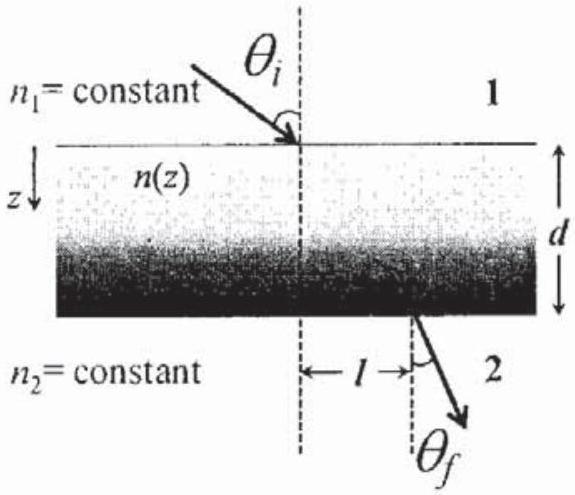
A transparent slab of thickness d has a refractive index n(z) that increases with z. Here z is the vertical distance inside the slab, measured from the top. The slab is placed between two media with uniform refractive indices n1 and n2(>n1), as shown in the figure. A ray of light is incident with angle θi from medium 1 and emerges in medium 2 with refraction angle θf with a lateral displacement l.
Which of the following statement(s) is(are) true?
(A)n1sinθi=n2sinθf✓ Correct
(B)n1sinθi=(n2−n1)sinθf
(C)l is independent of n2✓ Correct
(D)l is dependent on n(z)✓ Correct
Answer: (A), (C), (D)
Solution
Snell's Law at boundaries: At the top surface: n1sinθi=n(0)sinθ0
At the bottom surface: n(d)sinθd=n2sinθf
Since the ray passes through the continuously varying medium, by the principle of continuity and Snell's law applied at each infinitesimal layer, we have:
n1sinθi=n(z)sinθ(z)=n2sinθf
Therefore, n1sinθi=n2sinθf. (A) is correct, (B) is incorrect.
The lateral displacement l depends on the path the ray takes through the slab, which is determined by n(z). However, once θi is fixed, θf is determined by the relation above, independent of the specific form of n(z) or n2 (as long as the ray emerges). The displacement l depends on n(z) but not on n2. (C) and (D) are correct.
JEE Advanced · 2016 · 22 May 2016 · Paper 1 · One or more correct options