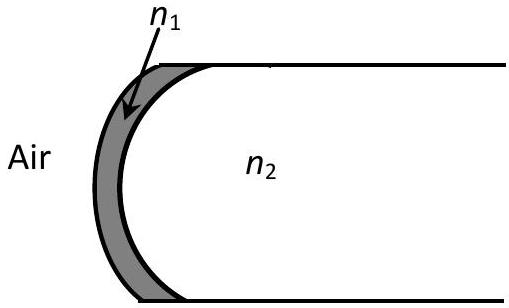
A transparent thin film of uniform thickness and refractive index n1=1.4 is coated on the convex spherical surface of radius Rat one end of a long solid glass cylinder of refractive index n2=1.5, as shown in the figure. Rays of light parallel to the axis of the cylinder traversing through the film from air to glass get focused at distance f1 from the film, while rays of light traversing from glass to air get focused at distance f2 from the film. Then
(A)∣f1∣=3R✓ Correct
(B)∣f1∣=2.8R
(C)∣f2∣=2R✓ Correct
(D)∣f2∣=1.4R
Answer: (A), (C)
Solution
**Air to glass (finding f1):**
First refraction (air to film): v1n1−∞1=Rn1−1, giving v1=n1−1n1R=0.41.4R=3.5R.
Second refraction (film to glass): v2n2−v1n1=Rn2−n1. Substituting: v21.5−3.5R1.4=R0.1, so v21.5=R0.1+R0.4=R0.5, giving v2=3R. So ∣f1∣=3R, option (A).
**Glass to air (finding f2):**
First refraction (glass to film): v1n1−∞n2=−Rn1−n2, giving v1=n2−n1n1R=0.11.4R=14R.
Second refraction (film to air): v21−v1n1=−R1−n1. Substituting: v21−14R1.4=R0.4, so v21=R0.4+R0.1=R0.5, giving v2=2R. So ∣f2∣=2R, option (C).
JEE Advanced · 2014 · 25 May 2014 · Paper 1 · One or more correct options