JEE Advanced · 2011 · 10 Apr 2011 · Paper 2 · Work, Power & Energy

WhatsApp Email
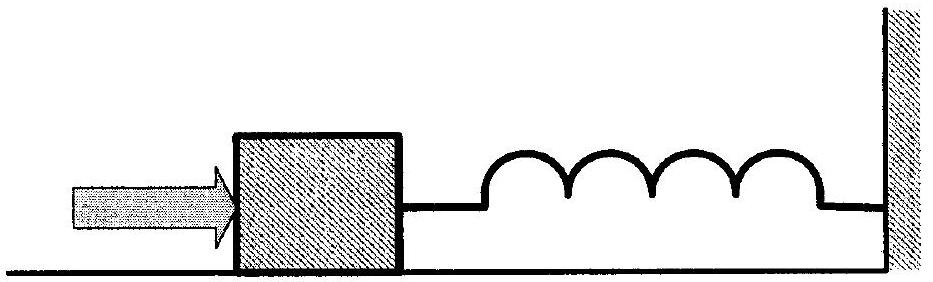
A block of mass 0.18 kg is attached to a spring of force-constant 2 N/m. The coefficient of friction between the block and the floor is 0.1. Initially the block is at rest and the spring is un-stretched. An impulse is given to the block as shown in the figure. The block slides a distance of 0.06 m and comes to rest for the first time. The initial velocity of the block in is . Then N is

Answer: 4

Solution

By work-energy theorem: . Substituting values: . Solving: m/s m/s. Therefore N = 4.

JEE Advanced · 2011 · 10 Apr 2011 · Paper 2 · Integer answer

More JEE Advanced questions on Work, Power & Energy

  1. A disk of radius with uniform positive charge density is placed on the plane with its center at the origin. The Coulomb potential along the -axis is

    A particle of positive charg …
    JEE Advanced 2022View solution →
  2. A particle is moved along a path AB-BC-CD-DE-EF-FA, as shown in figure, in presence of a force N, where x and y are in meter and . The …
    JEE Advanced 2019View solution →
  3. A particle of mass is initially at rest at the origin. It is subjected to a force and starts moving along the -axis. Its kinetic energy changes with time as , where is a positive constant of appropriate dimensions. Which of the foll …
    JEE Advanced 2018View solution →
  4. Two identical uniform discs roll without slipping on two different surfaces and (see figure) starting at and with linear speeds and , respectively, and always remain in contact with the surfaces. If they reach and with the same linear spee …
    JEE Advanced 2015View solution →
  5. A particle of unit mass is moving along the x-axis under the influence of a force and its total energy is conserved. Four possible forms of the potential energy of the particle are given in column I (a and are constants). Match the potential energies in column I …
    JEE Advanced 2015View solution →
  6. Consider an elliptically shaped rail PQ in the vertical plane with and . A block of mass 1 kg is pulled along the rail from P to Q with a force of , which is always parallel to line PQ (see the figure given). Assuming no frictional …
    JEE Advanced 2014View solution →