Given below are two statements. One is labelled as Assertion (A) and the other is labelled as Reason (R).
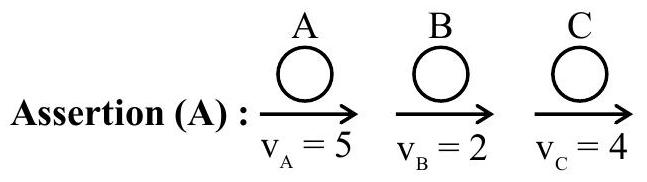
Three identical spheres of same mass undergo one dimensional motion as shown in figure with initial velocities vA=5m/s,vB=2m/s,vC=4m/s If we wait sufficiently long for elastic collision to happen, then vA=4m/s,vB=2m/s,vC=5m/s will be the final velocities.
Reason (R) : In an elastic collision between identical masses, two objects exchange their velocities.
In the light of the above statements, choose the correct answer from the options given below :Three spheres in motion
(A)Both (A) and (R) are true but (R) is NOT the correct explanation of (A)
(B)(A) is true but (R) is false
(C)Both (A) and (R) are true and (R) is the correct explanation of (A).
(D)(A) is false but (R) is true✓ Correct
Answer: (D)
Solution
In an elastic collision between two equal masses, momentum and kinetic energy conservation together force the two bodies to simply exchange velocities — this is Reason (R), a standard and correct result.
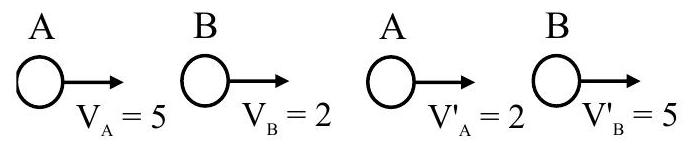
To check Assertion (A), trace the collisions as they actually occur along the line, in the order A, B, C, with vA=5, vB=2, vC=4 m/s. Since A is faster than B, A collides with B first; being equal masses, they exchange velocities:
vA=2 m/s,vB=5 m/s,vC=4 m/s (unchanged)
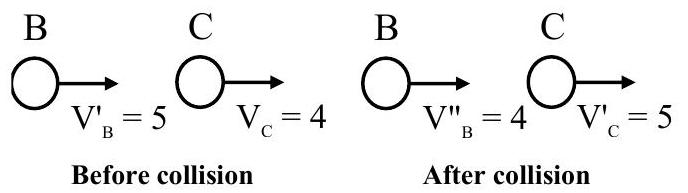
B, now moving at 5 m/s, is faster than C ahead of it and collides with C next, again exchanging velocities:
vB=4 m/s,vC=5 m/s
The final velocities are vA=2, vB=4, vC=5 m/s — not vA=4, vB=2, vC=5 m/s as the assertion claims. Assertion (A) is false, even though Reason (R) — the exchange-of-velocities rule itself — is true.Before collisionAfter collision
JEE Main · 2025 · 29 Jan 2025 · Shift 2 · Single correct option