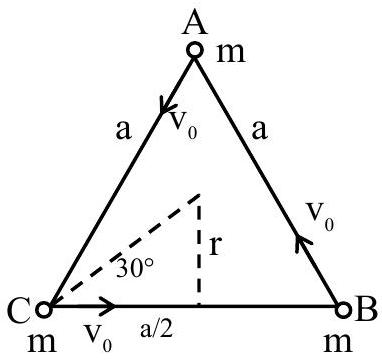
Three equal masses m are kept at vertices ( A,B,C ) of an equilateral triangle of side a in free space. At t=0, they are given an initial velocity VA=V0AC,VB=V0BA and VC=V0CB. Here, AC,CB and BA are unit vectors along the edges of the triangle. If the three masses interact gravitationally, then the magnitude of the net angular momentum of the system at the point of collision is :
(A)21amV0
(B)3 a m V0
(C)23amV0✓ Correct
(D)23amV0
Answer: (C)
Solution
The three masses sit at the vertices of an equilateral triangle of side a, each launched with speed V0 directed along one of the triangle's edges, in a cyclic pattern (A along AC, B along BA, C along CB). By this three-fold symmetry, the mutual gravitational forces keep the configuration symmetric at all times, and all three masses converge on the centroid at the same instant.
Angular momentum about the centroid G is conserved, since the gravitational forces between the particles are internal and produce no net external torque on the system. To find it at t=0 (which then holds all the way to the collision), note that the velocity of each mass lies exactly along the corresponding side of the triangle — the perpendicular distance from G to that line is the triangle's inradius,
r=23a
Each mass contributes angular momentum of magnitude mV0r about G, and by the cyclic symmetry all three contributions add in the same rotational sense:
L=3×mV0×23a=233mV0a=23mV0a
This is the magnitude of the net angular momentum of the system at the point of collision.Geometry of the system
JEE Main · 2025 · 29 Jan 2025 · Shift 2 · Single correct option