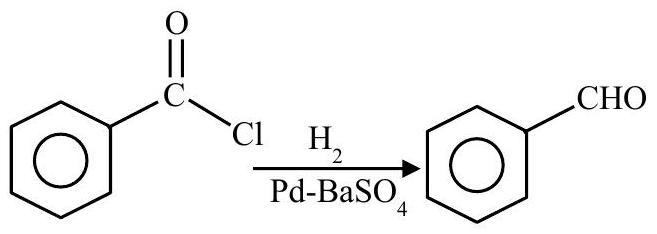
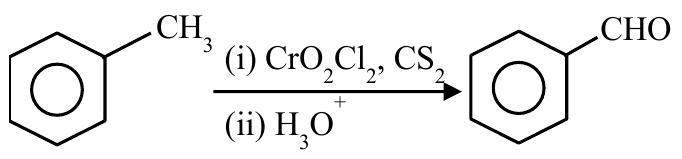
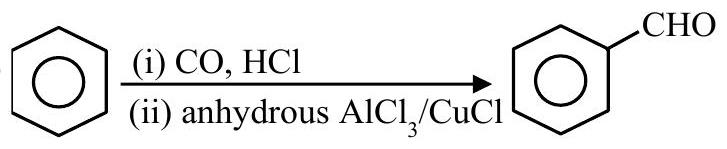
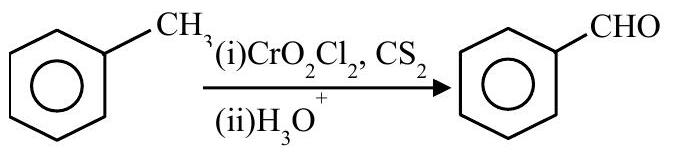
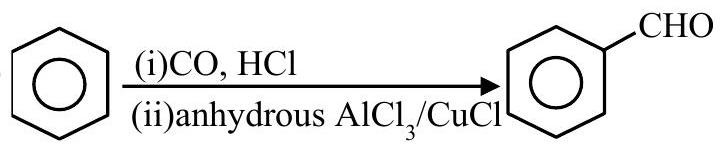
List-I (A) RCN(i) SnCl2,HCl (ii) H3O+RCHO (B) (see structure) (C) (see structure) (D) (see structure)
List-II (I) Etard reaction (II) Gatterman -Koch reaction (III) Rosenmund reduction (IV) Stephen reaction
Choose the correct answer from the options given below :
Answer: A → IV, B → III, C → I, D → II
Solution
Each named reaction converts a specific functional group to an aldehyde:
The Stephen reaction reduces a nitrile with SnCl2/HCl, and hydrolysis with H3O+ then gives the aldehyde: RCNSnCl2,HClRCH=NH⋅HClH3O+RCHO — this matches (A).
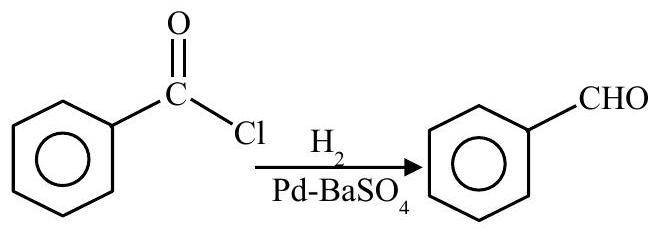
The Rosenmund reduction hydrogenates an acid chloride over a poisoned Pd−BaSO4 catalyst, which stops the reduction at the aldehyde stage rather than proceeding to the alcohol — this matches the acid-chloride-to-aldehyde conversion in (B).
The Etard reaction oxidizes a benzylic methyl group to an aldehyde using CrO2Cl2 in CS2 followed by hydrolysis — this matches (C).
The Gattermann–Koch reaction formylates an aromatic ring directly using CO/HCl with anhydrous AlCl3/CuCl as catalyst — this matches (D).
So (A) is the Stephen reaction, (B) is the Rosenmund reduction, (C) is the Etard reaction, and (D) is the Gattermann–Koch reaction.
JEE Main · 2025 · 24 Jan 2025 · Shift 2 · Match the columns