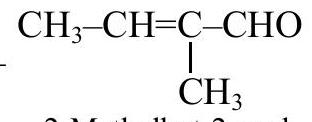
' x ' is the product which is obtained from propanenitrile and stannous chloride in the presence of hydrochloric acid followed by hydrolysis. ' y ' is the product which is obtained from the but-2-ene by the ozonolysis followed by hydrolysis. From the following, which product is not obtained when one mole of ' x ' and one mole of ' y ' react with each other in the presence of alkali followed by heating?
(A)2-Methylbut-2-enal
(B)Pent-2-enal
(C)2-Methylpent-2-enal
(D)3-Methylbut-2-enal✓ Correct
Answer: (D)
Solution
Propanenitrile with stannous chloride and hydrogen chloride, followed by hydrolysis (Stephen reduction), gives propanal, CH3CH2CHO (x). Ozonolysis of but-2-ene followed by hydrolysis cleaves the double bond to give two molecules of acetaldehyde, CH3CHO (y). With alkali and heat the two aldehydes undergo aldol condensation; both have α-hydrogens, so four α,β-unsaturated aldehydes are possible. Self-condensation of acetaldehyde gives but-2-enal, self-condensation of propanal gives 2-methylpent-2-enal, addition of the propanal enolate to acetaldehyde gives 2-methylbut-2-enal, and addition of the acetaldehyde enolate to propanal gives pent-2-enal. The branched aldehyde 3-methylbut-2-enal, (CH3)2C=CH-CHO, cannot arise from these partners and is not obtained.
JEE Main · 2026 · 23 Jan 2026 · Shift 1 · Single correct option