Which of the following compound can give positive iodoform test when treated with aqueous KOH solution followed by potassium hypoiodite.
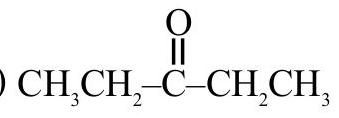
(A)(see structure)
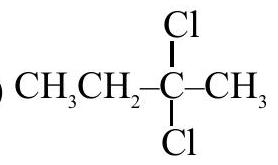
(B)(see structure)✓ Correct
(C)CH3CH2CH2CHO
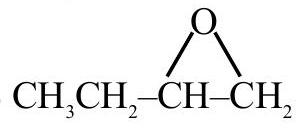
(D)(see structure)
Answer: (B)
Solution
A positive iodoform test (aq. KOH then KOI) requires either a methyl ketone (or an acetaldehyde-type group) or a compound that is converted into one.
The compound in option (3), CH3CH2CH2CHO, is an aldehyde with no methyl group attached to the carbonyl carbon, so it cannot give a positive iodoform test.
The compound in option (2) is a secondary chloride (CH3CH2CHCl CH3-type) that on treatment with aq. KOH is hydrolysed to the corresponding secondary alcohol (CH3CH2CH(OH)CH3), which has a CH3–CH(OH)– unit; potassium hypoiodite then oxidises this to the methyl ketone in situ and cleaves it to give a carboxylate salt and a yellow precipitate of iodoform:
CH3CH2CH(OH)CH3KOICH3CH2COO−K++CHI3↓
So option (2) gives the positive iodoform test.
JEE Main · 2024 · 09 Apr 2024 · Shift 2 · Single correct option