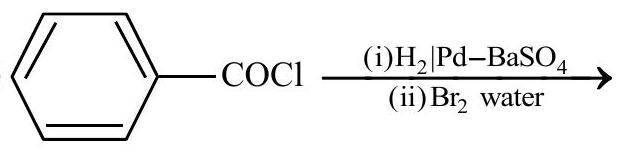
Consider the following reactions. From these reactions which reaction will give carboxylic acid as a major product? (A) R−C≡N (i) H+/H2O mild condition (B) R−MgX(i) CO2 (ii) H3O+ (C) R−C≡N(i) SnCl2/HCl (ii) H3O+ (D) R⋅CH2⋅OHPCC (E) (see structure)
Choose the correct answer from the options given below :
(A)A and D only
(B)A, B and E only
(C)B, C and E only
(D)B and E only✓ Correct
Answer: (D)
Solution
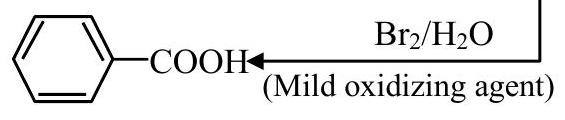
A carboxylic acid results only where the final product carries the −COOH group. A Grignard reagent adds to carbon dioxide and, after acid work-up, gives a carboxylic acid, so that pathway qualifies. In the benzoyl chloride route the acid chloride is first reduced by HX2/Pd−BaSOX4 (Rosenmund reduction) to benzaldehyde, which bromine water then oxidises to benzoic acid, so that route qualifies too. Mild acid hydrolysis of a nitrile stops at the amide; treatment with SnClX2/HCl followed by hydrolysis is the Stephen reduction, which gives an aldehyde; and PCC oxidation of a primary alcohol gives an aldehyde. The reactions yielding a carboxylic acid as the major product are the Grignard addition to carbon dioxide and the Rosenmund reduction followed by bromine-water oxidation.
JEE Main · 2025 · 02 Apr 2025 · Shift 2 · Single correct option