Many families come to engineering admissions with a vague sense that JEE Main and JEE Advanced are "two stages of the same exam". They are, in a sense — Main is the screening test for Advanced — but the two exams test genuinely different things, reward different kinds of preparation, and lead to different sets of institutions. Understanding the difference helps a student calibrate their preparation, decide how much to push for Advanced, and read their performance honestly.
This article puts the two exams side by side and walks through what changes between them — in syllabus, paper structure, problem style, marking, scoring, and what the score is used for.
Note: This article is written to be evergreen, but specific dates, fees, eligibility thresholds, and procedural details are set each year by the relevant authority — NTA, JoSAA, BITS Pilani, HSTES, or the institute concerned. Always cross-check the latest official notification before acting on anything time-sensitive.
The short summary
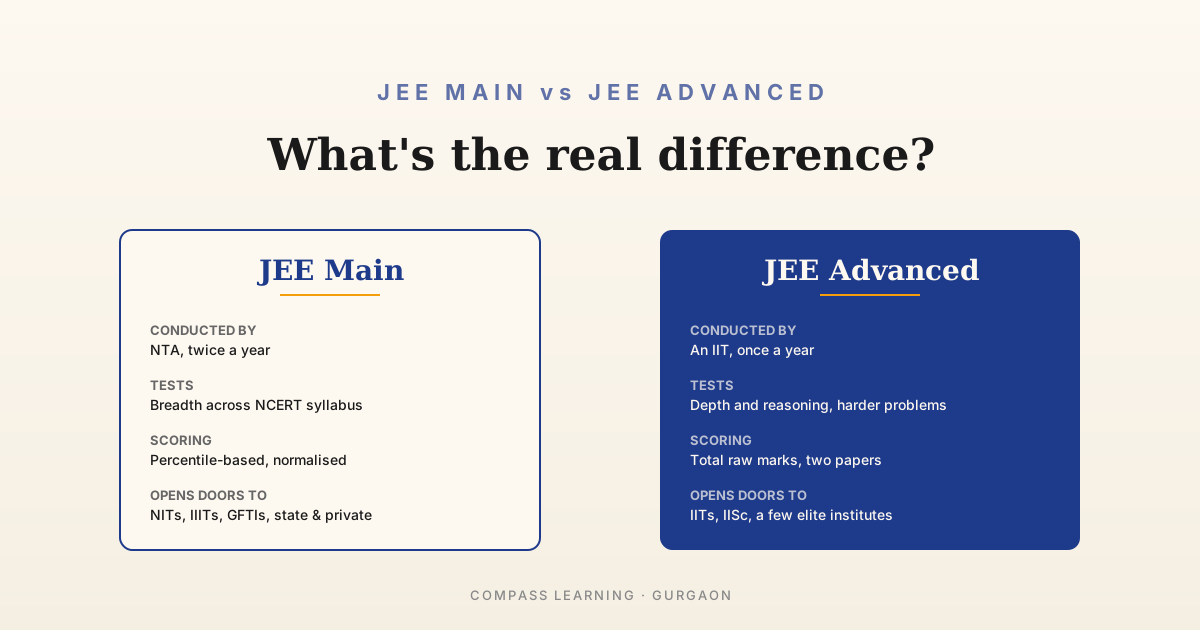
| Aspect | JEE Main | JEE Advanced |
|---|---|---|
| Conducted by | NTA | An IIT (rotates each year) |
| Sessions per year | Two (Jan-Feb, April) | One (May-June) |
| Eligibility | Class XII pass, Phy + Maths + (Chem/Bio/Bio-tech/Tech-Vocational) | Top ~2.5 lakh from JEE Main |
| Attempts | Three consecutive years from Class XII pass | Two attempts in two consecutive years |
| Papers | Paper 1 (B.E./B.Tech) — 1 paper; Paper 2A (B.Arch), Paper 2B (B.Plan) optional | Paper 1 and Paper 2, both compulsory, same day |
| Format | Computer-based | Computer-based |
| Question types | MCQ + numerical-value | MCQ (single + multiple), numerical-value, paragraph, match-the-following |
| Marking | +4 / −1 (MCQ), +4 / −1 (numerical, recently) | Variable per question type, sometimes with partial credit |
| Scoring system | Percentile-based, normalised across shifts | Total raw marks across both papers |
| Used for | NITs, IIITs, GFTIs, many state and private universities, plus eligibility for Advanced | IITs (primary); IISc and a few others |
| Difficulty | Moderate — broad but bounded by NCERT depth | High — same syllabus, much deeper application |
This is the skeleton. The differences in spirit are where the real distinction lies.
Difference in syllabus — small in words, large in depth
The syllabus for both exams is built on the NCERT Class XI and XII curriculum for Physics, Chemistry, and Mathematics. On paper, they overlap heavily. JEE Advanced traditionally has a few additional topics or sub-topics, and a few omissions, compared to Main — the differences are small in volume.
The bigger difference is in depth of treatment.
A Physics problem in JEE Main might give you a system with two known quantities and ask you to find a third, with a clear path to the answer. Plug in the formulas, do the arithmetic, you're done.
A Physics problem in JEE Advanced might give you the same system but with one variable hidden in a way that requires you to set up a coupled equation, recognise a subtle conservation principle, and then arrive at the answer through two or three reasoning steps. The formulas are the same; the path is harder to see.
This is the single most important distinction. Main rewards knowing the syllabus thoroughly. Advanced rewards applying the syllabus to unfamiliar problems.
A useful test: pick any JEE Main problem and a JEE Advanced problem on the same concept. Time yourself. Most students find that the Main problem takes 1–2 minutes and the Advanced problem takes 5–8 minutes — and the Advanced problem usually requires a moment of "ah, I see what's going on" before the calculation can begin.
Difference in paper structure — variety vs uniformity
JEE Main's structure is uniform. Three subjects, mostly multiple-choice plus a few numerical-value questions, +4/−1 marking, three hours. Once you've sat for a few mock papers, the format holds no surprises.
JEE Advanced's structure varies year to year. A single paper may contain:
- Single-correct-answer multiple choice
- Multiple-correct-answer multiple choice (partial credit possible)
- Numerical-value questions
- Match-the-following questions
- Paragraph-based questions (two or three questions on a shared passage)
The marking scheme is also more intricate. In multi-correct questions, choosing some of the correct options without choosing any wrong ones earns partial credit. Choosing even one wrong option in such a question can earn a negative mark even if you got the other selections right. The exact rules for each section are announced at the start of the paper, and reading them carefully on exam day is essential.
The implication: JEE Advanced rewards a candidate who can adapt to the question type on the day, in addition to knowing the subject.
Difference in scoring — percentile vs raw marks
JEE Main's percentile-based scoring is a normalisation mechanism — different shifts get slightly different papers, and the percentile makes the scores comparable across shifts. The final rank is calculated from percentile, with up to seven decimal places to break ties.
A consequence: in JEE Main, your raw marks alone don't tell you your rank. The same raw marks could give you slightly different percentiles depending on how everyone else performed that year.
JEE Advanced uses total raw marks across both papers, with subject-wise and aggregate minimum thresholds. Your rank is determined by your marks, simply. The ranks are released as the Common Rank List (CRL), plus category-specific rank lists derived from it.
This means in Advanced, you can predict your rank reasonably well from your marks once you know how the cohort performed — answer keys are released, and the cohort's distribution of marks is published. In Main, the percentile is opaque until NTA computes it.
Difference in what the score is used for
The "leverage" of a good JEE Main score is broad. It opens:
- NITs (31 institutes, ~24,000 seats)
- IIITs (~25 institutes, ~7,000 seats)
- GFTIs (~30+ institutes, ~6,000 seats)
- State quota seats at many state engineering colleges
- Direct admission at many private universities (BMU, Shiv Nadar, Bennett, and others use JEE Main scores)
- Eligibility for JEE Advanced
The leverage of a good JEE Advanced score is narrow but elite:
- IITs (23 institutes, ~17,000 seats)
- IISc Bangalore (a small number of seats for some undergraduate programmes)
- A handful of other institutes (IISERs, IIPE, RGIPT)
JEE Advanced does not get you into NITs or BITS. NITs use JEE Main; BITS uses BITSAT.
This is sometimes a useful framing: JEE Main is for the engineering ecosystem broadly; JEE Advanced is specifically for IITs.
Difference in difficulty — and what that means for prep
JEE Advanced is harder than JEE Main. This is not controversial. But what does "harder" actually mean for a student's preparation?
A few patterns we've seen and that are corroborated by experienced teachers and senior students:
The JEE Main syllabus is the foundation for both. Almost everyone who's serious about Advanced first builds a thorough JEE Main level command of the syllabus. Without that base, attempting Advanced-level problems is frustrating and unproductive.
The Advanced-specific preparation is a layer on top. Practising Advanced-level problems, learning the multi-step reasoning patterns, getting comfortable with the variable paper structure — this is typically the work of Class XII, especially the second half, for students aiming at IITs.
A high JEE Main score doesn't automatically mean a high Advanced score. A 99+ percentile in Main is necessary but not sufficient for an IIT rank. The skills that produce a 99 percentile in Main (consistency, accuracy, syllabus coverage) are different from the skills that produce a top-1000 rank in Advanced (problem-solving under pressure, ability to engage with unfamiliar problems).
A relatively lower JEE Main rank can sometimes produce a surprising Advanced rank, in either direction. We've seen students with a percentile in the 96–97 range do well in Advanced, and students with 99+ in Main not perform as well in Advanced. The two exams measure related but distinct abilities.
When to attempt which
The standard pattern for a serious aspirant:
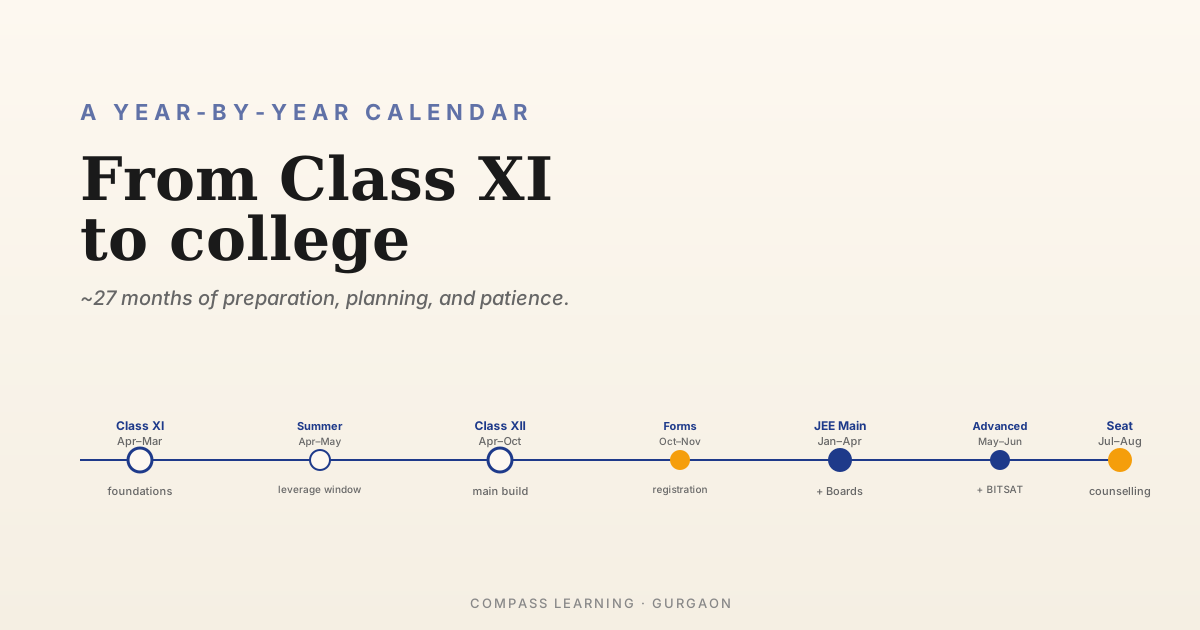
- JEE Main Session 1 (January–February of Class XII): Most students attempt this. Even if preparation isn't fully polished, the experience is valuable.
- Class XII Boards (Feb–April): Run in parallel, slightly stressful, manageable for a well-prepared student.
- JEE Main Session 2 (April): The improvement session. Most strong candidates write both. The better score is used.
- JEE Advanced (May–June): For the top ~2.5 lakh from Main. Most IIT-aspiring students attempt this.
- Subsequent year (drop year, if taken): Repeat Main and Advanced. Two attempts allowed for Advanced; three years of Main eligibility from Class XII pass.
The decision to take a drop year for Advanced is a separate, deliberate one — discussed in more detail below in the planning context.
Which one matters more, for whom
Different students need different framings:
- For a student aiming at IIT. Advanced is the goal, Main is the gate. Preparation is calibrated for Advanced; Main usually follows from Advanced-quality preparation. A safety net of BITSAT or a state CET is wise.
- For a student aiming at top NITs or IIITs. Main is the primary exam; Advanced is a bonus you write if you qualify. Preparation is calibrated for Main's breadth and accuracy. Advanced preparation isn't necessary unless you specifically want to.
- For a student aiming at private universities or a broader set of colleges. Main is the primary exam, with backup exams (BITSAT, VITEEE, state CETs) widening the options. Advanced is optional and worth attempting if you qualify, but not the focus.
- For a student who's unsure of their target. Prepare for JEE Main thoroughly first. By the time Main results are out, you'll have a clearer sense of where you stand. Advanced preparation in the last few months is workable for a strong Main scorer.
Knowing your bracket calibrates how you spend your time. A student aiming at "any good engineering college" who spends six months chasing Advanced-level problems while their Main fundamentals are shaky has misallocated their effort. So has a student aiming at IIT who's only doing Main-level practice in Class XII.
A practical note on "which is more important"
The honest answer is: both matter, but for different things. For a student who'll be content with a good NIT, JEE Main is more important. For a student whose specific goal is an IIT, JEE Advanced is decisive — Main is just the door.
There's no universal ranking. The right question isn't "which exam is more important?" but "which exam is more important for what I'm aiming at?"
Where to read next
For the individual exams: JEE Main Complete Guide and JEE Advanced Complete Guide.
For counselling: JoSAA Counselling Process: How IIT, NIT and IIIT Seats Are Allocated.
For cutoff trends across both: Understanding Cutoffs and Closing Ranks.
For the bigger picture: JEE, BITSAT and Beyond: A Complete Guide to Engineering Admissions in India.
Have questions about your specific situation?
We're at Ardee City, Sector 52, Gurgaon. Drop by anytime, or give us a call. Always happy to chat through strategy with parents and students — no pitch, no pressure, just a conversation about what makes sense for you.