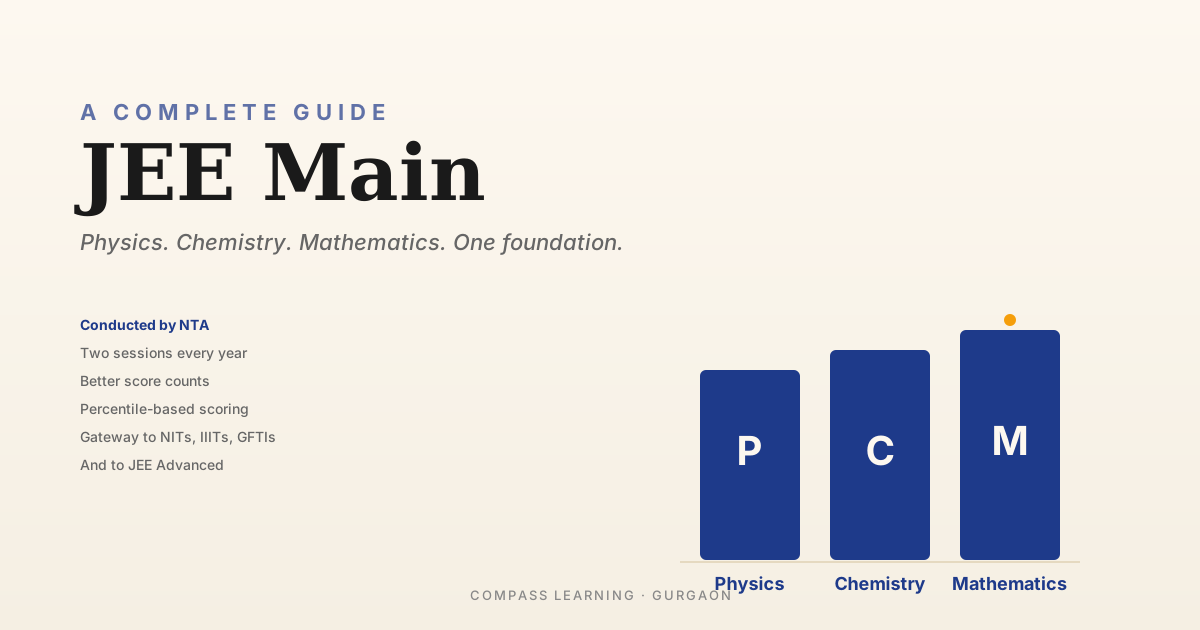
JEE Main is the entrance exam most Indian engineering aspirants build their preparation around. It's conducted by the National Testing Agency (NTA), runs in two sessions each year, and a good score opens doors to the NITs, IIITs, GFTIs, several state and private universities, and — for the top scorers — to JEE Advanced and the IITs.
This guide walks through everything a parent or student should know about JEE Main: what the exam looks like, how it's scored, how to think about the two sessions, and what the score is actually used for. We've kept it evergreen, so you'll see "usually" and "typically" more often than calendar dates — for the latest dates, see our annual update article.
Note: This article is written to be evergreen, but specific dates, fees, eligibility thresholds, and procedural details are set each year by the relevant authority — NTA, JoSAA, BITS Pilani, HSTES, or the institute concerned. Always cross-check the latest official notification before acting on anything time-sensitive.
What JEE Main actually tests
JEE Main is a computer-based test (CBT) held across hundreds of cities in India and a few abroad. There are three papers, but most students only think about Paper 1:
- Paper 1 — B.E./B.Tech. This is the engineering paper. Physics, Chemistry, and Mathematics. This is what you mean when you say "JEE Main".
- Paper 2A — B.Arch. For architecture admissions. Includes Mathematics, an Aptitude Test, and a Drawing Test.
- Paper 2B — B.Planning. For planning admissions. Includes Mathematics, an Aptitude Test, and a Planning-based section.
You can sit for Paper 1 alone, Paper 2A alone, Paper 2B alone, or any combination. Most students write only Paper 1. The rest of this guide focuses on Paper 1.
Paper 1 structure
Paper 1 has three subjects, equally weighted: Physics, Chemistry, Mathematics. Total duration is three hours. The number of questions and the exact split between multiple-choice and numerical-answer types has shifted over the years, but the broad pattern is steady:
- A set of multiple-choice questions per subject (4 options, one correct).
- A set of numerical-value questions per subject (you type in the answer; no options shown).
Marking is straightforward but worth understanding clearly:
- Correct answer: +4 marks.
- Wrong multiple-choice answer: −1 mark.
- Wrong numerical answer: in recent years there has been negative marking on these too. Check the latest information notice before the exam.
- Unattempted: 0 marks.
A maximum total of 300 marks is typical (100 per subject), though the exact number can vary slightly year to year. The exam is conducted in English, Hindi, and several regional languages — you choose your medium during the form.
The syllabus
The JEE Main syllabus is built on the NCERT Class XI and Class XII curriculum for Physics, Chemistry, and Mathematics. It's broad but not bottomless. NTA publishes the official syllabus on its website each year, and changes between years are usually small and clearly highlighted.
Some general orientation:
- Mathematics covers calculus (differential, integral, applications), algebra (sequences, complex numbers, matrices, determinants), coordinate geometry (lines, conics, 3D), trigonometry, probability, statistics, and vectors. About 16 chapters of substantive material.
- Physics covers mechanics, thermodynamics, waves and oscillations, electrostatics, current electricity, magnetism, electromagnetic induction, optics, modern physics, and a small amount of practical/electronic content. About 21 chapters.
- Chemistry is split into Physical, Inorganic, and Organic. Physical chemistry leans mathematical; Inorganic leans on the periodic table and reactions; Organic leans on reaction mechanisms and named reactions.
We have detailed subject-specific articles that go deeper into each subject's strategy — see the strategy section at the end of this article.
How scoring really works: percentile, not raw marks
This is the part that confuses most parents on first reading, and it's worth taking slow.
JEE Main is conducted in multiple shifts across multiple days. Even when the same syllabus is tested, different shifts get slightly different papers — that's unavoidable at this scale. To make scores comparable across shifts, NTA uses a percentile-based scoring system, not raw marks.
Here's what that means in plain terms:
- After the exam, NTA calculates each candidate's raw marks within their own shift.
- Then it converts those raw marks into a percentile that ranks the candidate against everyone in that shift.
- That percentile is the score that's reported.
A 99 percentile score means you did better than 99% of candidates in your shift. A 90 percentile score means you did better than 90%. The percentile is a number between 0 and 100, with up to seven decimal places to break ties.
The final rank used for counselling is calculated by combining percentiles across all four subjects in a specific way. The exact formula and any year-on-year tweaks are described in NTA's information bulletin.
One important consequence: a single raw mark can correspond to slightly different percentiles in different years, depending on how the overall cohort performed. So when someone says "I got 220 marks in JEE Main", that number alone doesn't tell you their rank — the percentile and final rank depend on how everyone else did.
The two sessions
JEE Main is held in two sessions each year — usually one in January–February and another in March–April. A student can write either, or both.
If a student writes both, only the better of the two scores is used for the final rank. This makes the second session a natural retake opportunity without any penalty for trying twice.
A few patterns we see among well-prepared students:
- Most strong candidates attempt both sessions. Session 1 doubles as a low-stakes practice run, and Session 2 benefits from the experience.
- A small number choose to write only Session 2 — typically students who feel their preparation will be substantially stronger by April than it would be in January.
- Writing only Session 1 and skipping Session 2 is uncommon for students aiming high. Even a small improvement in Session 2 can mean a meaningful rank jump.
The form for Session 2 opens around the time Session 1 results are declared, so you can decide based on how Session 1 went.
What JEE Main score is used for
A JEE Main score does several things at once. Understanding the full picture helps you see why this one exam matters across so many admissions:
1. Admission to NITs, IIITs, and GFTIs through JoSAA counselling. The 31 NITs, ~25 IIITs, and ~30+ Government-Funded Technical Institutes use your JEE Main rank for seat allocation through the centralised JoSAA process. (See our JoSAA Counselling Explained article for how that works.)
2. Eligibility for JEE Advanced. The top ~2.5 lakh JEE Main scorers each year are eligible to write JEE Advanced, the entrance for IIT admissions. JEE Main doesn't get you into an IIT directly — Advanced does — but it's the gate to Advanced.
3. Admission to many state and private universities. Several universities accept JEE Main scores as their admission criterion, either as the sole basis or as a major component. This includes a number of Delhi NCR colleges and several private universities elsewhere in India. The specifics vary year to year, so check each college's admission notice.
4. Tie-breaking and state quotas. For some state quotas and special categories, JEE Main rank plays a role alongside other criteria.
This is why JEE Main preparation is the foundation of an aspirant's year, even for students whose primary target is an IIT.
Eligibility
JEE Main has historically had broad eligibility:
- Age: There has been no upper age limit in recent years. (Earlier rules had one; the current information bulletin is the authoritative source.)
- Qualifying exam: You must have passed (or be appearing in) Class XII or equivalent.
- Subjects in Class XII: Physics and Mathematics are mandatory; the third subject must be Chemistry, Biology, Biotechnology, or a Technical Vocational subject.
- Attempts: Three consecutive years of eligibility — meaning you can write JEE Main in the year you pass Class XII and for two years after.
Each year's information bulletin spells out the exact eligibility rules. Read it carefully before applying, especially if there's anything non-standard about your case (gap year, international board, etc.).
What counts as a "good" score
This is the question every parent asks, and the honest answer is: it depends on what you're aiming for.
A few rough orientations (these vary by year and category, so treat them as ranges, not promises):
- For top NITs and IIITs in Computer Science: typically a 99+ percentile and a very strong Mathematics paper.
- For mid-tier NITs and IIITs across branches: typically 95+ percentile.
- For JEE Advanced qualification: the cutoff moves each year, but historically a 90+ percentile has been roughly the threshold.
- For a wide range of state and private universities: scores well below 90 percentile can still open meaningful options, especially through state quotas.
The article on Understanding Cutoffs and Closing Ranks goes into more detail on how these numbers translate into specific colleges and branches.
How the year flows
The yearly cycle is described in detail in our hub article, The Engineering Admissions Roadmap. In short:
- October–November: Registration opens for Session 1.
- January–February: Session 1 exam dates; results within two weeks.
- February–March: Registration opens for Session 2.
- April: Session 2 exam dates; results shortly after.
- April onwards: JEE Advanced eligibility list released, Advanced registration opens.
For the current year's specific dates, see our annual update article.
Where to read next
If you're new to the whole landscape: start with our hub article, The Engineering Admissions Roadmap.
If you're about to fill the form: read How to Fill the JEE Main Application Form: Step-by-Step and Document Checklist for Engineering Entrance Forms together.
If you want to understand the IIT path: JEE Advanced: A Complete Guide.
If you're past the exam and into counselling: JoSAA Counselling Explained and Understanding Cutoffs and Closing Ranks.
If you want strategy: JEE Main vs JEE Advanced: What's the Real Difference and A Year-by-Year Calendar from Class XI.
Have questions about your specific situation?
We're at Ardee City, Sector 52, Gurgaon. Drop by anytime, or give us a call. Always happy to chat through strategy with parents and students — no pitch, no pressure, just a conversation about what makes sense for you.