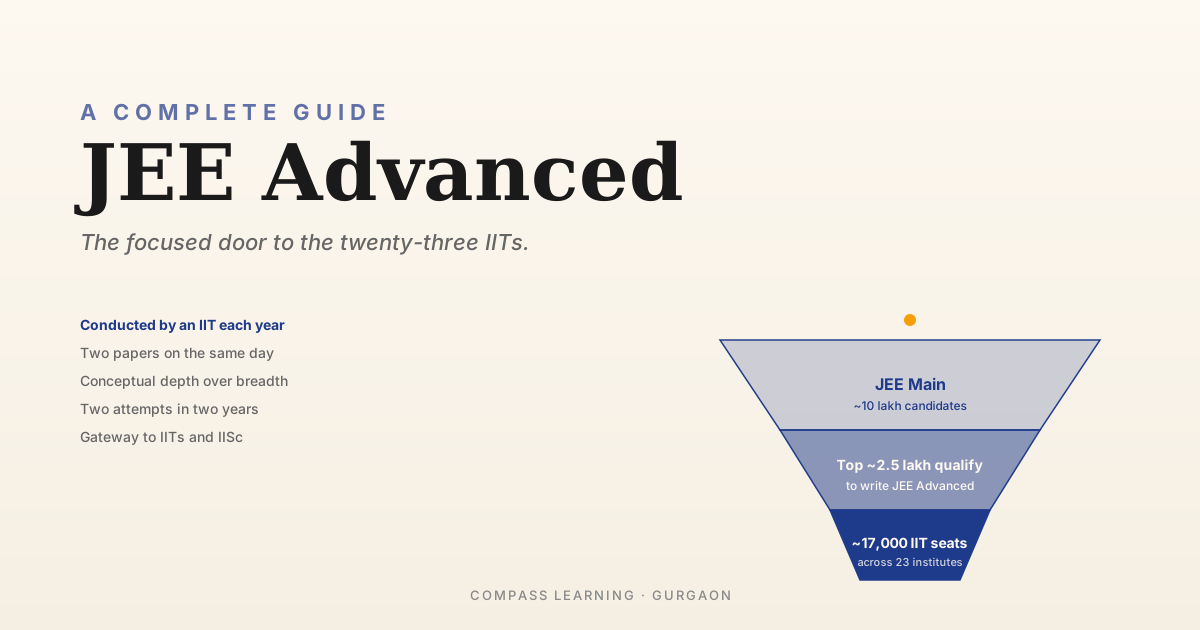
JEE Advanced is the entrance exam for the Indian Institutes of Technology (IITs). It happens once a year, and only candidates who qualify through JEE Main can write it. If JEE Main is the broad gate to engineering admissions, JEE Advanced is the focused door to the twenty-three IITs.
This article walks through what JEE Advanced is, who can write it, what the paper looks like, and how the score is used. As with our other guides, we've kept it evergreen — for this year's specific dates, see our annual update article.
Note: This article is written to be evergreen, but specific dates, fees, eligibility thresholds, and procedural details are set each year by the relevant authority — NTA, JoSAA, BITS Pilani, HSTES, or the institute concerned. Always cross-check the latest official notification before acting on anything time-sensitive.
What makes Advanced different from Main
Many parents reasonably ask: why two exams? The short answer is that Main and Advanced are calibrated for different purposes.
JEE Main is a large-scale screening exam. It tests breadth across the NCERT-based syllabus and produces a percentile-based rank used across NITs, IIITs, GFTIs, and several state and private universities.
JEE Advanced is a smaller, more selective exam. It tests depth — the same broad syllabus, but with problems that require multiple steps of reasoning, careful application of concepts, and a tolerance for being shown something unfamiliar. Students often describe a JEE Advanced problem as one where you "read it twice, sketch it once, and then think for two minutes before writing anything."
The exam is conducted each year by one of the IITs, on a rotating basis. The IIT in charge is called the "organising institute" for that year.
Who can write JEE Advanced
JEE Advanced eligibility comes through JEE Main. Specifically:
- Top JEE Main scorers qualify. Each year, roughly the top 2.5 lakh JEE Main candidates (across all categories, with proportional reservation in each) become eligible to register for Advanced. The exact number is set by the organising institute each year.
- Number of attempts: A student can attempt JEE Advanced a maximum of two times, in two consecutive years.
- Age limit: There has historically been an upper age limit (typically born on or after 1 October of a specified year, with a five-year relaxation for reserved categories). The current information bulletin is the authoritative source.
- Class XII requirement: Pass Class XII or equivalent.
A student already admitted to an IIT through a previous JEE Advanced is generally not allowed to write again, with limited exceptions for those who accepted and then withdrew before the academic session began. Specifics change; read the bulletin carefully.
Paper structure
JEE Advanced has two papers — Paper 1 and Paper 2 — held on the same day, with a break in between. Both papers are compulsory.
- Each paper is three hours.
- Each paper has all three subjects: Physics, Chemistry, Mathematics.
- The format is computer-based.
Where Advanced differs from Main is in the variety of question types. A single paper may contain:
- Single-correct-answer multiple choice questions
- Multiple-correct-answer multiple choice questions (where partial credit may apply)
- Numerical-value questions
- Match-the-following questions
- Paragraph-based questions (a short passage followed by two or three questions)
The marking scheme varies by question type and changes from year to year. In some types, an attempted-and-wrong answer carries a negative mark; in others (like multi-correct), partial credit applies if you've marked at least one correct option without marking any wrong ones. The exact rules are spelled out at the start of each paper, so a candidate must take a minute to read them carefully on exam day.
Total marks vary across years — typically in the range of 360 across both papers, though this is not fixed.
The syllabus
The JEE Advanced syllabus is largely the same as the JEE Main syllabus, with a few important differences:
- Some Class XII topics that are lightly covered in Main are given more emphasis in Advanced.
- The depth of treatment expected is greater. A Main problem might ask you to apply a single concept correctly; an Advanced problem may require combining two or three concepts in a non-obvious way.
- Advanced traditionally includes a few topics that are slightly outside the Main syllabus or treated at a more rigorous level.
The official syllabus is published on the JEE Advanced website each year and is well worth printing out and keeping on a desk through the prep year.
Architecture: AAT
Students who want to study architecture at an IIT — specifically B.Arch at IIT Roorkee or IIT Kharagpur — write an additional test called the Architecture Aptitude Test (AAT) after JEE Advanced. AAT tests drawing, three-dimensional perception, architectural awareness, and aesthetic sensitivity.
AAT is only for students who have qualified JEE Advanced and want B.Arch at one of those two IITs. The test is held shortly after JEE Advanced results, and there's a separate, much smaller application. For students aiming at architecture elsewhere (NIT Bhopal, SPA Delhi, etc.), JEE Main Paper 2A is the relevant exam, not AAT.
How scoring and ranks work
JEE Advanced uses your total marks across both papers to compute a Common Rank List (CRL). Category-wise lists (OBC-NCL, SC, ST, EWS, PwD) are derived from this.
A few mechanical points:
- There are subject-wise minimum marks (a small threshold to ensure no subject has been completely abandoned) and an aggregate minimum mark. Both must be met to be ranked.
- The exact thresholds vary each year, and category-specific relaxations apply.
- Once ranks are released, those with valid ranks are eligible to participate in JoSAA counselling for IIT seats.
What the score is used for
The JEE Advanced rank is used for:
- IIT admissions through JoSAA counselling. This is its primary purpose. (See JoSAA Counselling Explained.)
- Indian Institute of Science (IISc) Bangalore for some undergraduate programs.
- A small number of other institutes — including IISERs, IIPE, RGIPT, and a few others — use JEE Advanced ranks for admission to specific programs alongside other channels.
JEE Advanced rank is not used by the NITs or most other engineering colleges — they go by JEE Main.
The two-year window
Because a student gets two attempts in two consecutive years, many aspirants think carefully about timing:
- Most students write Advanced in their Class XII year and again the next year if needed. The second attempt is a "drop year" — a year of focused preparation after Class XII, taken to improve the rank.
- A drop year is a real strategic decision with personal, financial, and academic dimensions. It can be the right call for students who feel their first attempt did not reflect their capability, and the wrong call for those who'd genuinely benefit more from starting college. The decision is best made conversation with a teacher who has seen the student's preparation closely.
We'd avoid framing the second attempt as something for "fallback"; it's a deliberate choice with its own logic.
How the year flows for Advanced
- April: JEE Main Session 2 results. The top scorers receive an eligibility communication for Advanced.
- Late April / early May: JEE Advanced registration opens for eligible candidates. The window is short — usually about a week.
- Late May / early June: JEE Advanced exam (both papers on the same day).
- Mid-June: Provisional answer key released. A short window opens for candidates to raise objections, which are reviewed.
- A few days after the answer-key window closes: Final result and ranks.
- June onwards: JoSAA counselling begins.
For this year's specific dates, see our annual update article.
Where to read next
For the bigger picture: our hub article, The Engineering Admissions Roadmap.
For the exam that precedes this one: JEE Main: A Complete Guide.
For what happens after the result: JoSAA Counselling Explained and Understanding Cutoffs and Closing Ranks.
For comparing the two exams: JEE Main vs JEE Advanced: What's the Real Difference.
Have questions about your specific situation?
We're at Ardee City, Sector 52, Gurgaon. Drop by anytime, or give us a call. Always happy to chat through strategy with parents and students — no pitch, no pressure, just a conversation about what makes sense for you.