JEE Main · 2026 · 05 Apr 2026 · Shift 1 · Compounds Containing Nitrogen

WhatsApp Email
Benzyl isocyanide can be obtained from
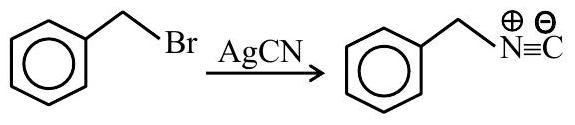
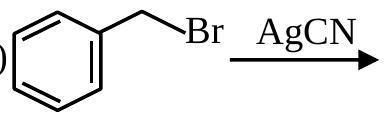
(A) (see structure)
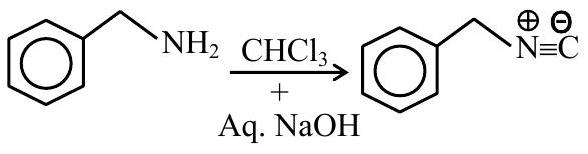
(B) (see structure)
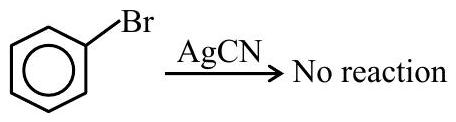
(C) (see structure)
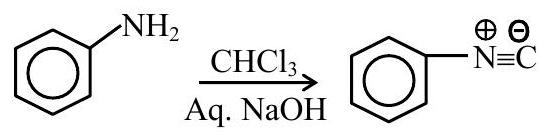
(D) (see structure)
(E) (see structure)

Choose the correct answer from the options given below :
Structure A
A
Structure B
B
Structure C
C
Structure D
D
Structure E
E
  1. (A)A and B only✓ Correct
  2. (B)A and C only
  3. (C)B and D only
  4. (D)D and E only

Answer: (A)

Solution

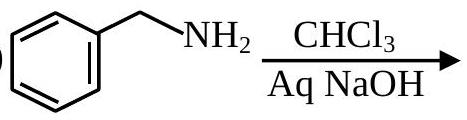
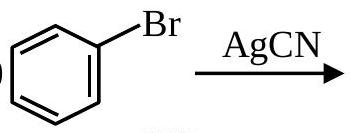
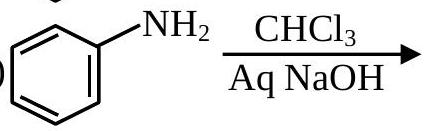
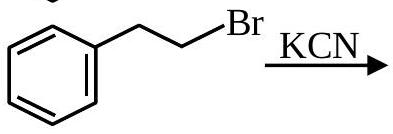
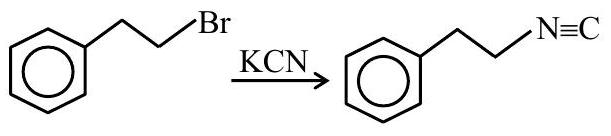
Benzyl isocyanide, , demands that nitrogen, not carbon, becomes bonded to the benzylic carbon. Benzyl bromide with silver cyanide gives this isocyanide, because the largely covalent lets nitrogen form the bond, so route A succeeds. Benzylamine, a primary amine, with chloroform and alkali undergoes the carbylamine reaction to yield benzyl isocyanide, so route B succeeds. Bromobenzene with , and aniline by the carbylamine route, would both give phenyl isocyanide, with nitrogen joined directly to the ring, not benzyl isocyanide. Phenylethyl bromide with potassium cyanide gives a nitrile, with carbon attached and one carbon longer, not an isocyanide. Benzyl isocyanide is obtained from routes A and B.

JEE Main · 2026 · 05 Apr 2026 · Shift 1 · Single correct option
More JEE Main questions on Compounds Containing Nitrogen

  1. A hydrocarbon 'P' on reaction with HCl gives an optically active compound 'Q' which on reaction with one mole of ammonia gives compound 'R' …
    JEE Main 2026View solution →
  2. An organic compound (P) on treatment with aqueous ammonia under hot condition forms compound (Q) which on heating with and KOH forms compound (R) having molecular formula . Names of and R …
    JEE Main 2026View solution →
  3. Consider the following reaction sequence

    The percentage of nitrogen in product 'T' formed is _____ %. (Nearest integer)

    (Given molar mass in H: 1, C: 12, N: 14, O: 16)
    JEE Main 2026View solution →
  4. 'A' is a neutral organic compound (M. F : ). On treatment with aqueous , 'A' forms a compound ' B ' which is soluble in dilute acid. ' B ' on treatment with aqueous …
    JEE Main 2026View solution →
  5. Consider the above sequence of reactions. The number of bromine atom(s) in the final product (P) will be:

    (1)
    (2)
    (3) pH neutralisation
    (4)
    (5) …
    JEE Main 2026View solution →
  6. The final product is :
    JEE Main 2026View solution →