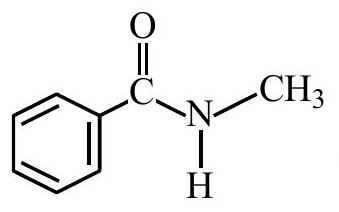
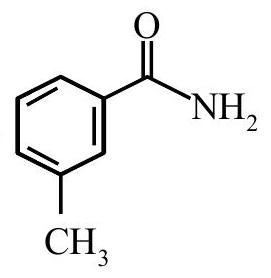
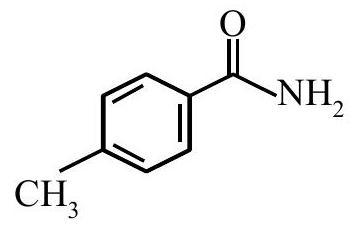
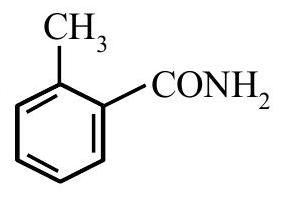
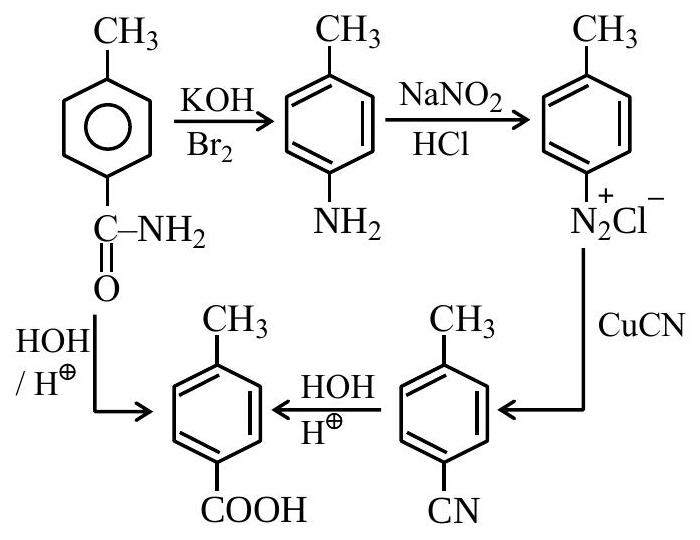
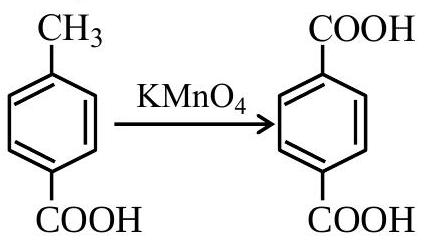
'A' is a neutral organic compound (M. F : C8H9ON ). On treatment with aqueous Br2/HO(−), 'A' forms a compound ' B ' which is soluble in dilute acid. ' B ' on treatment with aqueous NaNO2/HCl(0−5∘C) produces a compound ' C ' which on treatment with CuCN/NaCN produces 'D' Hydrolysis of 'D' produces ' E ' which is also obtainable from the hydrolysis of 'A'. 'E' on treatment with acidified KMnO4 produces 'F'. 'F' contains two different types of hydrogen atoms. The structure of ' A ' is
(A)(see structure)
(B)(see structure)
(C)(see structure)✓ Correct
(D)(see structure)
Answer: (C)
Solution
The amide A (C8H9NO) reacting with bromine in alkali undergoes the Hofmann bromamide degradation, which shortens the chain by one carbon to a primary aromatic amine B that dissolves in dilute acid. Diazotisation of B at 0-5∘C gives the diazonium salt C, and CuCN/NaCN (Sandmeyer) replaces the diazonium group by a nitrile to give D; hydrolysis of this nitrile gives the acid E, which must also be the hydrolysis product of A. For the two routes to meet, the ring methyl that survives in E must sit where oxidation by acidified permanganate turns it into a second carboxyl and yields an acid F with only two kinds of hydrogen, namely terephthalic acid, whose four ring hydrogens are equivalent and whose two carboxyl hydrogens are equivalent. This places the methyl para to the amide, so A is 4-methylbenzamide (p-toluamide).
JEE Main · 2026 · 22 Jan 2026 · Shift 1 · Single correct option