JEE Advanced · 2025 · 18 May 2025 · Paper 2 · Compounds Containing Nitrogen

WhatsApp Email
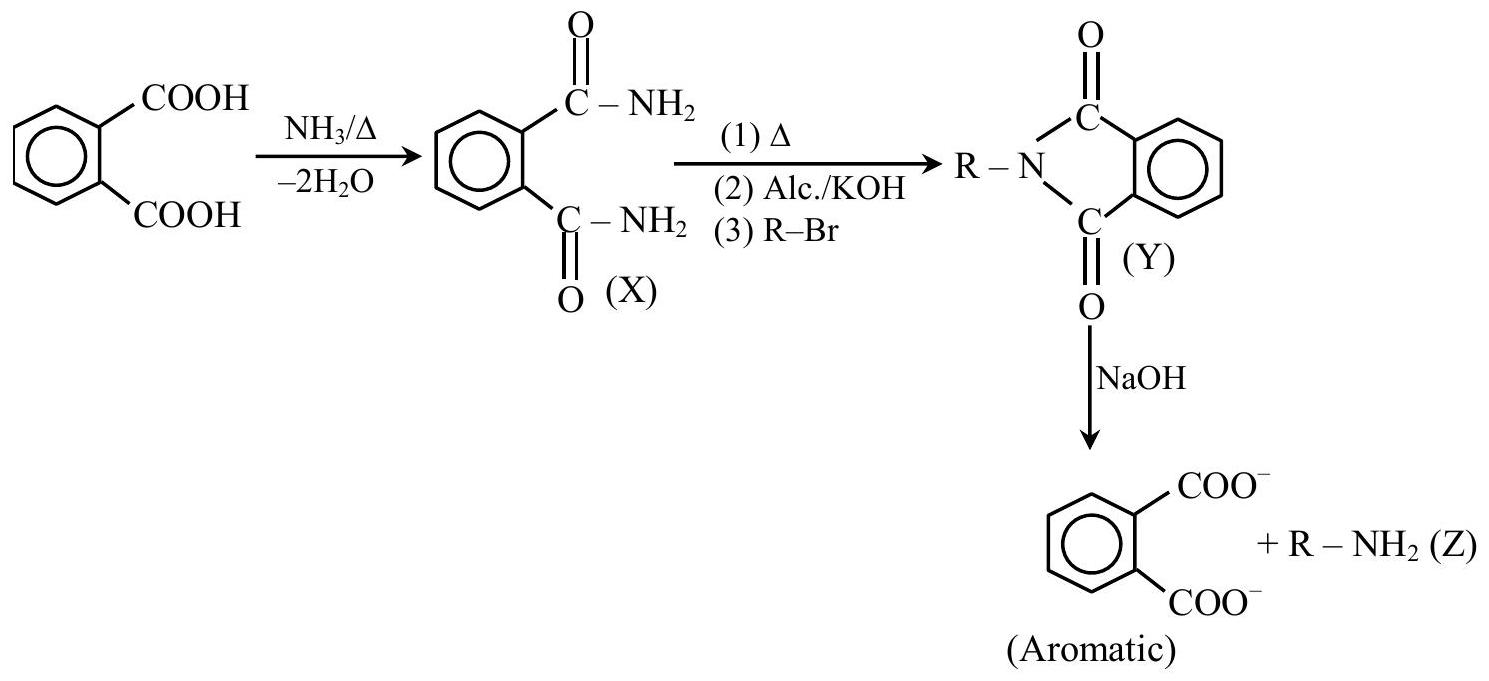
The correct statement(s) is(are)
  1. (A)Both X and Y are oxygen containing compounds.✓ Correct
  2. (B)Y on heating with forms isocyanide.
  3. (C)Z reacts with Hinsberg's reagent.✓ Correct
  4. (D)Z is an aromatic primary amine.

Answer: (A), (C)

Solution

From the reaction sequence shown:

(A) is correct: Both X and Y are oxygen-containing compounds based on the reaction pathway.

(B) is incorrect: The carbylamine test (CHCl₃/KOH forming isocyanide) is specific for primary amines, not Y.

(C) is correct: Z reacts with Hinsberg's reagent (benzenesulfonyl chloride), which is a test for amines. Primary and secondary amines react differently with this reagent.

(D) is incorrect: While Z is an amine, the structure shows it is not an aromatic primary amine based on the reaction sequence.

JEE Advanced · 2025 · 18 May 2025 · Paper 2 · One or more correct options

More JEE Advanced questions on Compounds Containing Nitrogen

  1. In the following reaction sequence, P, Q, S and T are the major products.

    The correct statement(s) about , , and is (are)
    JEE Advanced 2026View solution →
  2. A trinitro compound, 1, 3,5 tris-(4-nitrophenyl) benzene, on complete reaction with an excess of gives major product, which on treatment with an excess of at provides P as the product. P, …
    JEE Advanced 2023View solution →
  3. A trinitro compound, 1, 3,5 tris-(4-nitrophenyl) benzene, on complete reaction with an excess of gives major product, which on treatment with an excess of at provides P as the product. P, …
    JEE Advanced 2023View solution →
  4. Consider the following reaction sequence,

    the correct option(s) is(are)
    JEE Advanced 2022View solution →
  5. Correct option(s) for the following sequence of reactions is(are)
    JEE Advanced 2021View solution →
  6. Reaction of of Sn with HCl quantitatively produced a salt. Entire amount of the salt reacted with of nitrobenzene in the presence of required amount of HCl to produce 1.29 g of an organic salt (quantitatively).
    (Use Molar masses (in …
    JEE Advanced 2021View solution →