JEE Advanced · 2021 · 03 Oct 2021 · Paper 2 · Compounds Containing Nitrogen

WhatsApp Email
Reaction of of Sn with HCl quantitatively produced a salt. Entire amount of the salt reacted with of nitrobenzene in the presence of required amount of HCl to produce 1.29 g of an organic salt (quantitatively).
(Use Molar masses (in ) of H, C, N, O, Cl and Sn as 1, 12, 14, 16, 35 and 119, respectively).

The value of is ____.

Answer: 3.57

Solution

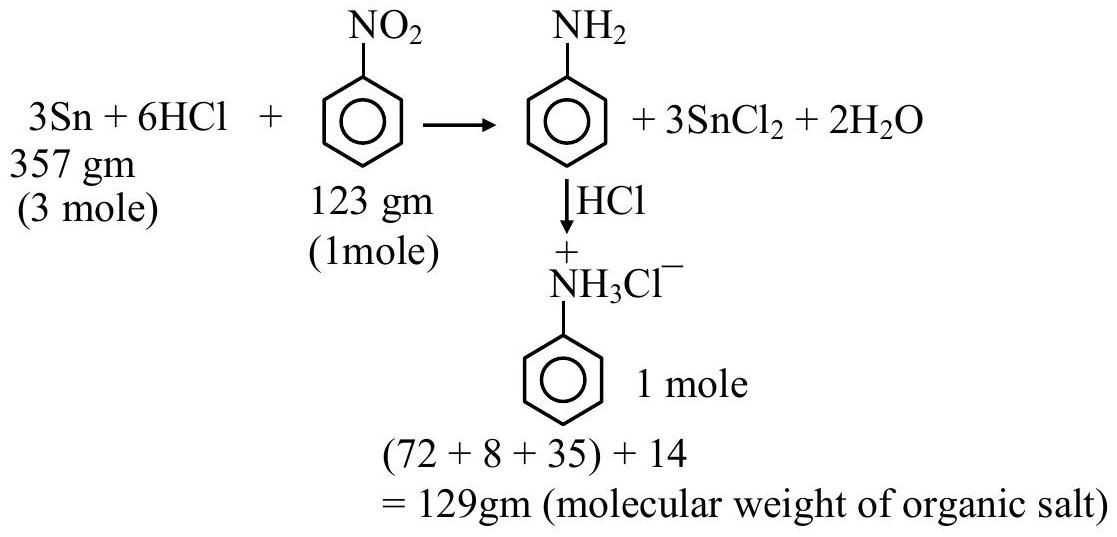
Sn reacts with HCl to form . This reduces nitrobenzene to aniline, which forms anilinium chloride () as the organic salt. Molar mass of anilinium chloride = 6(12) + 8(1) + 14 + 35 = 129 g/mol. Moles of organic salt = 1.29/129 = 0.01 mol. The reduction of nitrobenzene requires 3 moles of Sn per mole of nitrobenzene (). So 0.01 mol nitrobenzene requires 0.03 mol Sn. Mass of Sn = 0.03 × 119 = 3.57 g.

JEE Advanced · 2021 · 03 Oct 2021 · Paper 2 · Numerical answer
More JEE Advanced questions on Compounds Containing Nitrogen

  1. In the following reaction sequence, P, Q, S and T are the major products.

    The correct statement(s) about , , and is (are)
    JEE Advanced 2026View solution →
  2. The correct statement(s) is(are)
    JEE Advanced 2025View solution →
  3. A trinitro compound, 1, 3,5 tris-(4-nitrophenyl) benzene, on complete reaction with an excess of gives major product, which on treatment with an excess of at provides P as the product. P, …
    JEE Advanced 2023View solution →
  4. A trinitro compound, 1, 3,5 tris-(4-nitrophenyl) benzene, on complete reaction with an excess of gives major product, which on treatment with an excess of at provides P as the product. P, …
    JEE Advanced 2023View solution →
  5. Consider the following reaction sequence,

    the correct option(s) is(are)
    JEE Advanced 2022View solution →
  6. Correct option(s) for the following sequence of reactions is(are)
    JEE Advanced 2021View solution →