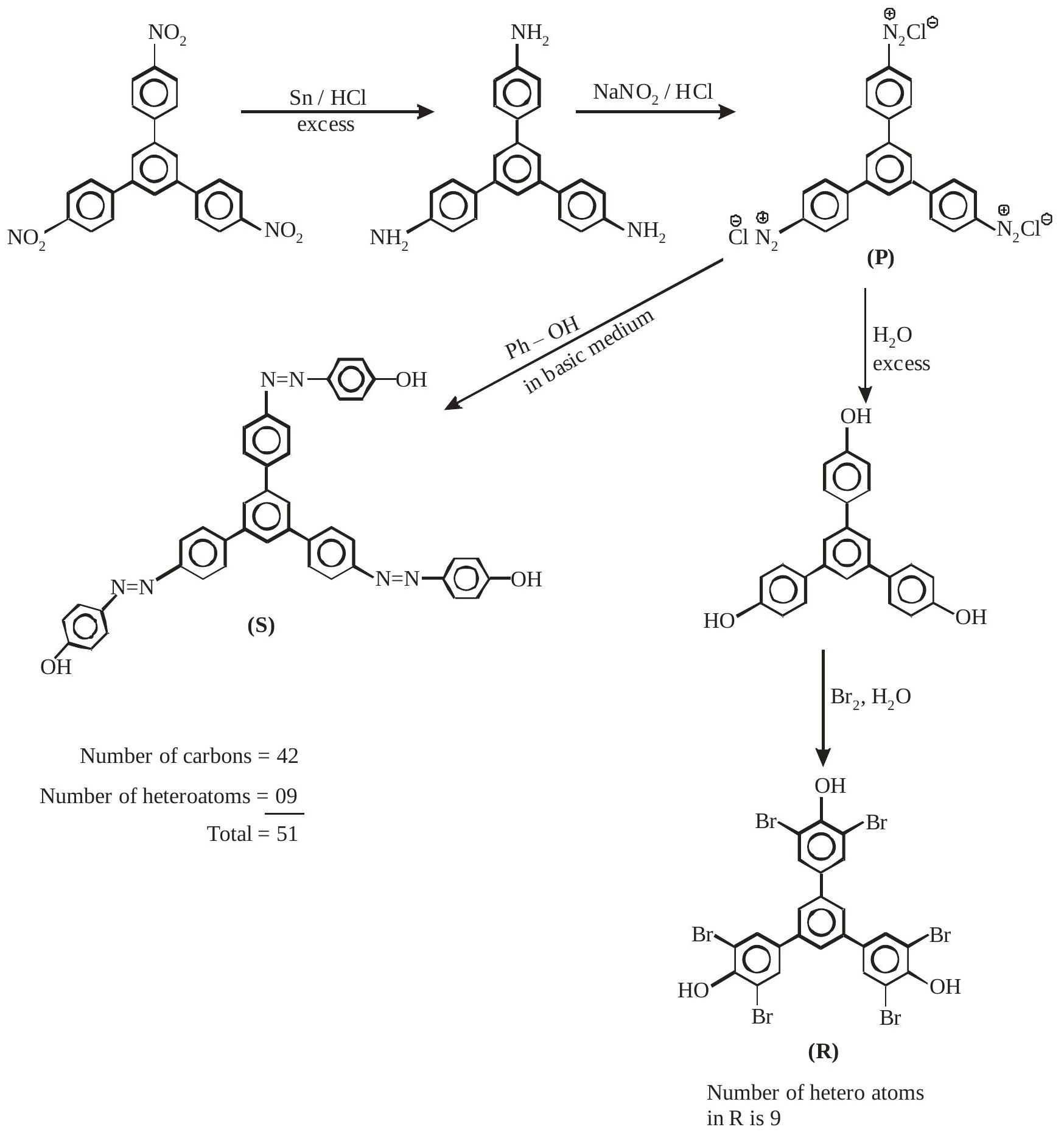
A trinitro compound, 1, 3,5 tris-(4-nitrophenyl) benzene, on complete reaction with an excess of Sn/HCl gives major product, which on treatment with an excess of NaNO2/HCl at 0∘C provides P as the product. P, upon treatment with excess of H2O at room temperature, gives the product Q. Bromination of Q in aqueous medium furnishes the product R. The compound P upon treatment with an excess of phenol under basic conditions gives the product S.
The molar mass difference between compounds Q and R is 474mol−1 and between compounds P and S is 172.5gmol−1.
The total number of carbon atoms and heteroatoms present in one molecule of S is ____. [Use: Molar mass in gmol−1 ]: H=1,C=12,N=14,O=16,Br=80,Cl=35.5 Atoms other than C and H are considered as heteroatoms
Answer: 51
Solution
From the previous analysis:
P is the tris-diazonium salt.
Treatment with phenol under basic conditions gives azo coupling product S.
Each diazonium group couples with one phenol molecule to form an azo linkage (−N=N−).
Structure of S:
Central benzene ring: 6 C
Three phenyl rings (from original compound): 3 × 6 = 18 C
Three phenol rings (from coupling): 3 × 6 = 18 C
Total C atoms: 6 + 18 + 18 = 42 C
Heteroatoms:
6 N atoms (from three azo groups: −N=N−)
3 O atoms (from three phenolic OH groups)
Total heteroatoms: 9
Total C + heteroatoms = 42 + 9 = 51
JEE Advanced · 2023 · 04 Jun 2023 · Paper 2 · Numerical answer