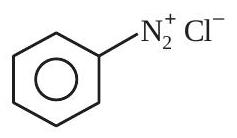
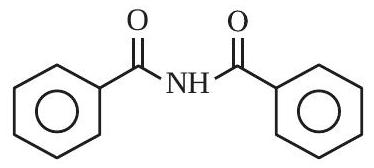
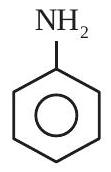
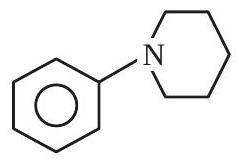
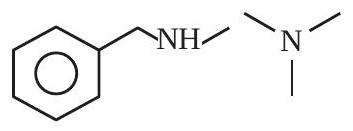
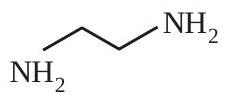
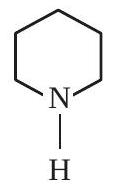
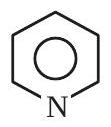
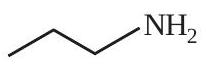
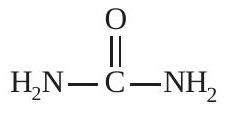
Number of compounds which give reaction with Hinsberg's reagent is ____.ABCDEFGHIJ
Answer: 5
Solution
Hinsberg's reagent, benzenesulfonyl chloride (C6H5SO2Cl), reacts with an amine only if it has a free N–H bond available for substitution. Primary amines (RNH2) give a sulfonamide with one remaining N–H that is acidic enough to dissolve in NaOH; secondary amines (R2NH) give a sulfonamide with no N–H left, which stays insoluble in NaOH. Tertiary amines have no N–H bond to begin with and do not react. Amides, diazonium salts, aromatic amines with the nitrogen locked in the ring (such as pyridine), and compounds with no nitrogen at all also fail to react.
Of the ten compounds shown, those carrying a free primary or secondary amino N–H — aniline, propylamine, ethylenediamine (with two primary −NH2 groups), N-methylbenzylamine, and piperidine — undergo the reaction. The amide, the diazonium salt, urea, pyridine, and the nitrogen-free hydrocarbon do not. This gives 5 compounds that react with Hinsberg's reagent.
JEE Main · 2024 · 01 Feb 2024 · Shift 2 · Integer answer