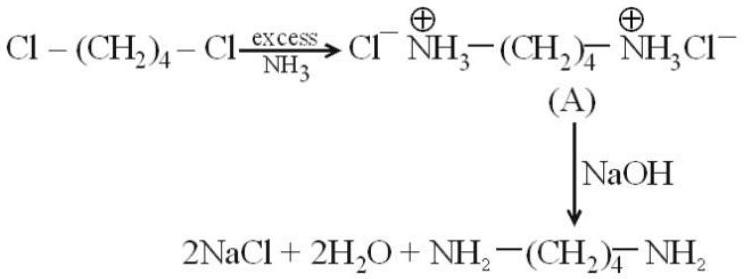
Cl-(CH2)4-Cl treated with excess ammonia undergoes two successive nucleophilic substitutions; using ammonia in large excess suppresses intramolecular cyclisation and favours the intermolecular pathway, giving the diammonium salt Cl−N+H3-(CH2)4-N+H3Cl− as intermediate A.
Treating A with NaOH deprotonates both ammonium centres, liberating the free diamine and the by-products NaCl and H2O: A+2NaOH→H2N-(CH2)4-NH2+2NaCl+2H2O.
So B is putrescine, H2N-(CH2)4-NH2.
JEE Main · 2024 · 27 Jan 2024 · Shift 2 · Single correct option