JEE Main · 2023 · 08 Apr 2023 · Shift 1 · Compounds Containing Nitrogen

WhatsApp Email
Match List I with List II:
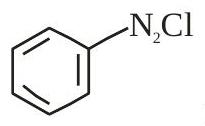
Benzenediazonium chloride is reacted with reagents in List I to form products in List II.

Answer: A → III, B → I, C → IV, D → II

Solution

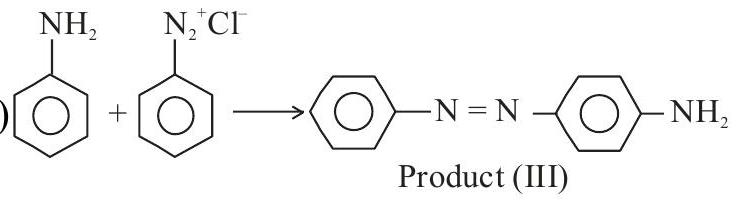
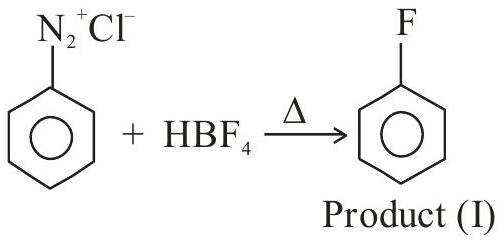
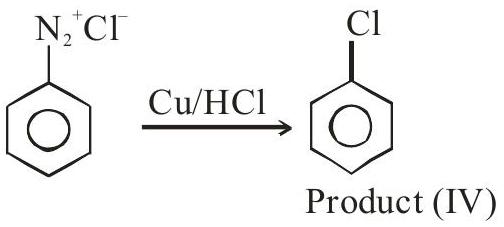
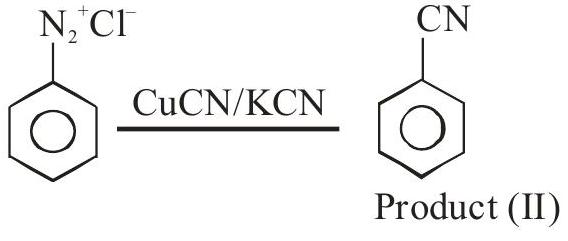
Benzenediazonium chloride reacts either by coupling or by loss of nitrogen, depending on the reagent. With aniline (reagent A) it couples at the para position to give the azo compound , which is product III. With followed by heating (B), the Balz–Schiemann reaction replaces the diazonium group by fluorine to give fluorobenzene, product I. With (C), the Gattermann reaction gives chlorobenzene, product IV. With (D), the Sandmeyer reaction gives benzonitrile, product II. The matching is A–III, B–I, C–IV, D–II.
Structure A
A
Structure B
B
Structure C
C
Structure D
D

JEE Main · 2023 · 08 Apr 2023 · Shift 1 · Match the columns
More JEE Main questions on Compounds Containing Nitrogen

  1. A hydrocarbon 'P' on reaction with HCl gives an optically active compound 'Q' which on reaction with one mole of ammonia gives compound 'R' …
    JEE Main 2026View solution →
  2. An organic compound (P) on treatment with aqueous ammonia under hot condition forms compound (Q) which on heating with and KOH forms compound (R) having molecular formula . Names of and R …
    JEE Main 2026View solution →
  3. Consider the following reaction sequence

    The percentage of nitrogen in product 'T' formed is _____ %. (Nearest integer)

    (Given molar mass in H: 1, C: 12, N: 14, O: 16)
    JEE Main 2026View solution →
  4. 'A' is a neutral organic compound (M. F : ). On treatment with aqueous , 'A' forms a compound ' B ' which is soluble in dilute acid. ' B ' on treatment with aqueous …
    JEE Main 2026View solution →
  5. Consider the above sequence of reactions. The number of bromine atom(s) in the final product (P) will be:

    (1)
    (2)
    (3) pH neutralisation
    (4)
    (5) …
    JEE Main 2026View solution →
  6. The final product is :
    JEE Main 2026View solution →