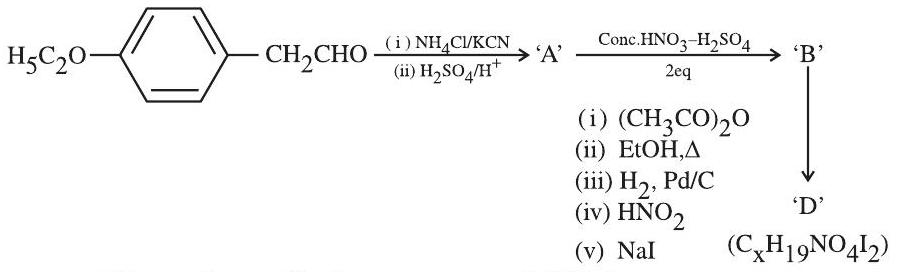
4-Ethoxyphenylacetaldehyde undergoes a Strecker synthesis: addition of hydrogen cyanide and ammonia, from NHX4Cl and KCN, gives an α-aminonitrile, and acidic hydrolysis turns it into the α-amino acid A, EtO−CX6HX4−CHX2−CH(NHX2)−COOH. Nitration with two equivalents of concentrated nitric and sulphuric acids places two nitro groups on the ring to give B. Then acetic anhydride acetylates the amino group, ethanol esterifies the acid to its ethyl ester, hydrogen over palladium reduces both nitro groups to amino groups, nitrous acid converts these to diazonium groups, and sodium iodide replaces each diazonium group by iodine. The product D is EtO−CX6HX2(I)X2−CHX2−CH(NHCOCHX3)−COOCX2HX5. Its carbons number six in the ring, two in the ethoxy group, one each in the two side-chain carbons, two in the acetyl group and three in the ethyl ester, a total of fifteen, in agreement with the formula CX15HX19NOX4IX2. The value of x is 15.