Every year, around September or October, a quiet shift happens in households across Delhi NCR. A parent watches their child's Class XII begin in earnest, and somewhere between the morning tea and the school WhatsApp notifications, a question arrives:
What exactly comes next?
When does the JEE form open? Is there only one JEE, or two? What is JoSAA — and why does that name keep coming up? Should we already be filling something? Are we late?
If you've felt that question — or watched your child feel it — this article is for you. We've written it as the map we wish someone had handed us when we started.
It won't tell you cut-offs or this year's exact dates. Those change every year. What it will do is lay out the territory: which exams exist, what they're for, how the whole year fits together, and how to think about decisions along the way. It's a map; you'll still walk the road.
Note: This article is written to be evergreen, but specific dates, fees, eligibility thresholds, and procedural details are set each year by the relevant authority — NTA, JoSAA, BITS Pilani, HSTES, or the institute concerned. Always cross-check the latest official notification before acting on anything time-sensitive.
A short tour of the main exams
For students aiming at engineering colleges in India, there's a small set of exams that account for most admissions. Knowing what each one is for is half the battle.
JEE Main is the big one. It's conducted by NTA twice a year — usually a January session and an April session — and a student can attempt both. The better score counts. The exam covers Physics, Chemistry, and Mathematics, and uses a percentile-based scoring system (more on this in our JEE Main: A Complete Guide). A good JEE Main score is the ticket to NITs, IIITs, GFTIs, and many state and private universities that accept JEE Main. It's also the gateway to JEE Advanced.
JEE Advanced is for IIT admissions. Only the top ~2.5 lakh JEE Main scorers qualify to write it, and it happens once a year — usually in late May or early June. It's a different kind of exam: harder, more conceptual, less syllabus-bound. Doing well in Advanced means a shot at the IITs; not doing well doesn't matter much elsewhere, because the rest of the system uses JEE Main scores.
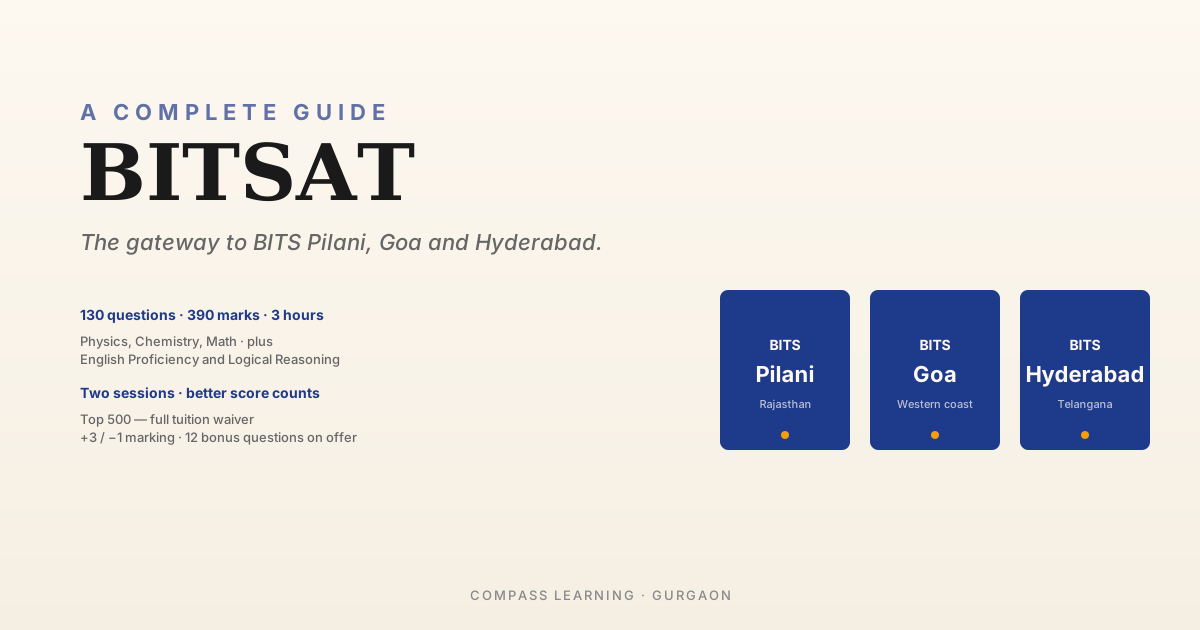
BITSAT is the entrance test for BITS Pilani (and BITS Goa and BITS Hyderabad). It's conducted by BITS itself, not NTA, and the syllabus has small but real differences — most notably an English and Logical Reasoning section in addition to PCM. BITSAT happens later in the year, usually around May–June, and most JEE-prep students take it as an extra option.
CUET-UG is the Common University Entrance Test. It's the gateway for central universities and several private universities, for both engineering and non-engineering programs. For an engineering aspirant, CUET matters mostly if you're considering colleges that use it — Delhi University's engineering programs, certain IIITs, and others. It's increasingly relevant but it's not the primary track for IIT/NIT/BITS aspirants.
State engineering exams exist for several states. The three that matter most for Delhi NCR students are:
- UPCET / AKTU for engineering colleges in Noida, Greater Noida, and across Uttar Pradesh
- MHT-CET for engineering colleges in Pune, Mumbai, and across Maharashtra
- KCET and COMEDK for Bangalore-area and Karnataka engineering
If you're a Delhi NCR family, the UP system is often the most directly relevant because of geography. We cover all three in detail in State Engineering Exams: UP, Maharashtra, Karnataka.
Private university tests are separate. VIT (Vellore) runs its own entrance — VITEEE. Manipal runs MET. Shiv Nadar, Ashoka, Bennett, Plaksha, Thapar, and Chandigarh University all have their own application processes that may or may not require an entrance test. We have a dedicated profile article on each of these colleges that walks through what they want.
That's the landscape. Most students will write two or three of these exams — typically JEE Main, JEE Advanced if they qualify, and one or two backup options from the list above.
How the year actually works
The thing that catches most families off-guard isn't which exams exist — it's how early the timeline starts. JEE Main registration usually opens in late October or early November of the year before the exam. So if your child is going to write JEE Main in early 2026, you're filling the form by November 2025. The Class XII board exams haven't even started yet.
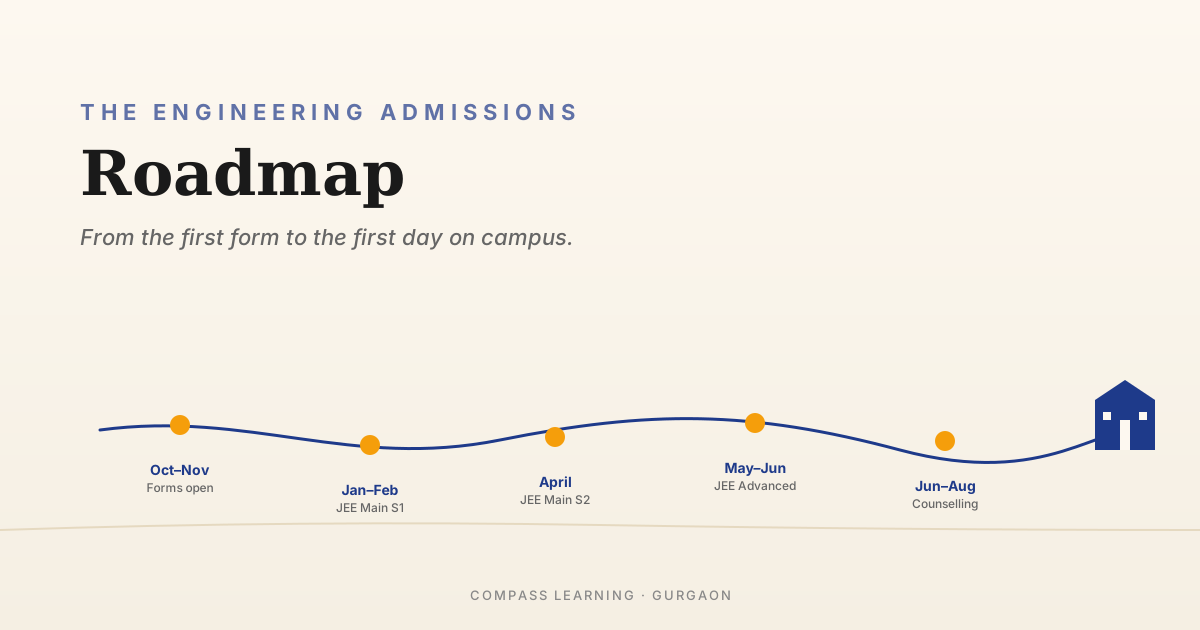
Here's how a typical year lays out:
October–November: JEE Main registration opens for the January session. The window stays open for about a month. This is also when you start collecting documents — photographs, signatures, certificates, ID proofs — that nearly every exam will want in slightly different formats. (We've put together a Document Checklist for Engineering Entrance Forms so you only have to do this once.)
December–January: Admit cards become available, and JEE Main Session 1 takes place — usually across multiple days in late January or early February. Results follow within a couple of weeks.
February–March: JEE Main Session 2 registration opens. Many students who weren't satisfied with Session 1 attempt Session 2. Class XII board exams happen in roughly the same window — yes, it's stressful, and yes, students handle it.
March–April: JEE Main Session 2 takes place. Other exam registrations begin opening — BITSAT, state CETs, VITEEE, university-specific tests.
April–May: JEE Main Session 2 results. JEE Advanced registration opens for qualified candidates. BITSAT and several state CETs are conducted.
May–June: JEE Advanced is conducted. State CETs and university tests continue. JEE Advanced result comes out roughly ten days after the exam.
June onwards: Counselling begins. This is the most-misunderstood phase. The exam is done; now the system has to allocate seats. Two major counselling processes happen:
- JoSAA Counselling is the centralized counselling for IITs, NITs, IIITs, and GFTIs. Students fill in their preferred branches and colleges, and the system allocates seats over multiple rounds based on JEE Advanced and JEE Main ranks. (See JoSAA Counselling Explained for the full mechanics.)
- CSAB Special Rounds are additional rounds for any seats that remained unfilled or got vacated after JoSAA.
State counsellings (UPCET, MHT-CET, KCET) and university-specific admissions also happen in this window, often in parallel. Many students juggle multiple admissions and pay small "seat blocking" fees at several colleges before finalizing.
By August or September, most students have a seat. By the time the academic year begins, this thirteen-month journey is over.
Different goals, different paths
There's no single "right" exam list. What you take depends on where you want to land. Here are the common patterns we see:
"We want to aim for IIT." Then JEE Main (both sessions if needed) → JEE Advanced is the core path. IITs are the most cherished destination for many engineering aspirants, and the preparation is built around that. Alongside, it's good strategy to keep a strong Plan B in place — most students write one or two additional exams to widen their options. BITSAT (for BITS Pilani, Goa, or Hyderabad) and VITEEE (for VIT Vellore) are popular choices. A state exam like UPCET is another common addition for Delhi NCR families. Each of these leads to a college worth studying at in its own right.
"We want a top NIT or IIIT." JEE Main is the only exam that matters. You'd still write Advanced if you qualify (it doesn't hurt, and there's no downside), but for NITs and IIITs the seat allocation goes by JEE Main rank via JoSAA. A backup exam is still a good idea for the same reason — keep options open.
"We're open to a good private engineering college close to home." This is where Delhi NCR families actually have a lot of options. Beyond JEE Main, you might write BITSAT (BITS Pilani is highly competitive but worth the shot), VITEEE, the IPU process for IP University colleges, and explore Shiv Nadar, Ashoka, Bennett, Plaksha, Thapar, and Chandigarh University through their own applications. Each of these has a dedicated profile article on this site covering admission, fees, and the kind of student they tend to attract.
"We're not sure yet." That's a reasonable place to be in Class XI or early Class XII. The honest advice is: focus on the JEE Main syllabus regardless. It overlaps heavily with most other engineering entrances. You can decide which specific extra exams to write closer to the application windows.
A word on counselling — the part nobody explains well
Most families enter the counselling phase exhausted from a year of exams, and that's exactly when the most consequential choices get made. Counselling is where you say which college and which branch you want, and the system allocates based on your rank.
A few principles worth knowing before you get there:
Fill more choices, not fewer. JoSAA lets you list a hundred or more choices. Use them. There's no benefit to listing only five — if your rank doesn't reach any of them, you get no seat.
Rank choices by what you actually want, not by what you think you'll get. The system runs through your list from top to bottom. Putting "what I'll probably get" at the top means you might miss something better that was actually within reach.
Branch versus brand is a real debate. A CS seat at a tier-2 NIT versus a Mechanical seat at a top NIT — there's no universal answer. We have a separate article on this; it's worth reading before counselling, not during.
You can change your mind across rounds. Counselling runs in rounds, and there are ways to upgrade or freeze your seat at each stage. Understanding this saves a lot of anxiety.
The full mechanics — choice filling, locking, freezing, sliding, withdrawing, reporting — are in our JoSAA Counselling Explained article.
What this series covers
This article is the hub. The rest of the series fills in the details:
Process & form-filling. How to Fill the JEE Main Application Form. Document Checklist for Engineering Entrance Forms.
The major exams. JEE Main: A Complete Guide. JEE Advanced: A Complete Guide. BITSAT: A Complete Guide. CUET-UG for Engineering. State Engineering Exams: UP, Maharashtra, Karnataka.
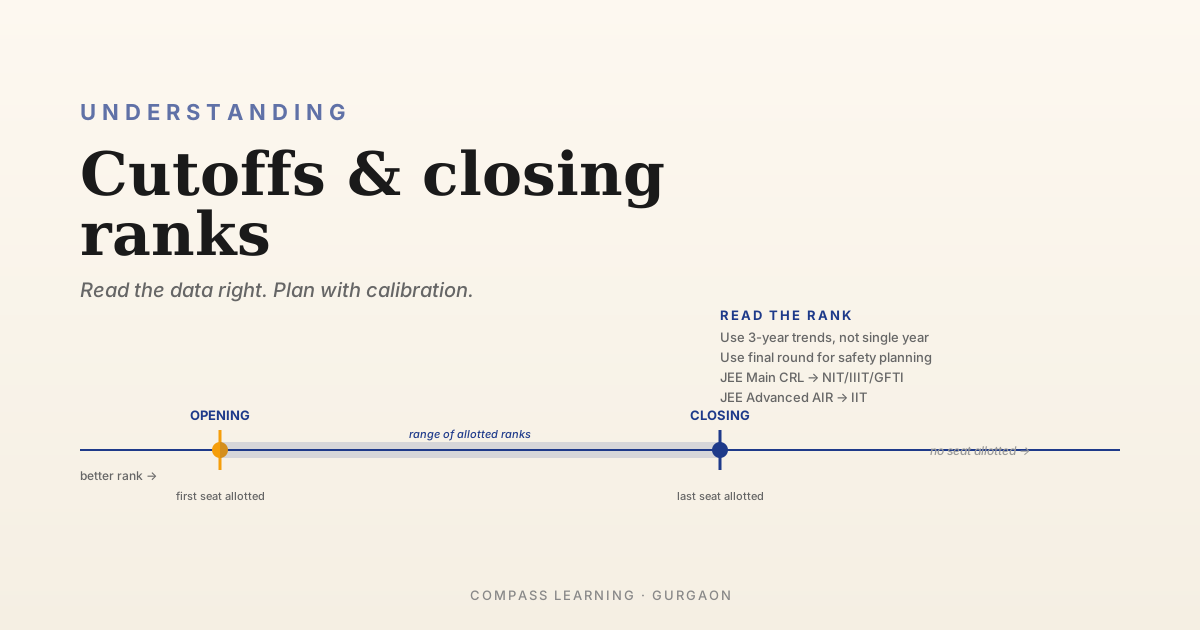
Counselling. JoSAA Counselling Explained. CSAB Special Rounds. Understanding Cutoffs and Closing Ranks.
Delhi NCR colleges. Engineering Colleges in Haryana. IIIT Delhi. DTU. NSUT. IPU. Shiv Nadar University Noida. Ashoka University. Bennett University. Thapar. Chandigarh University. Plaksha. BITS Pilani. VIT Vellore. Manipal MIT.
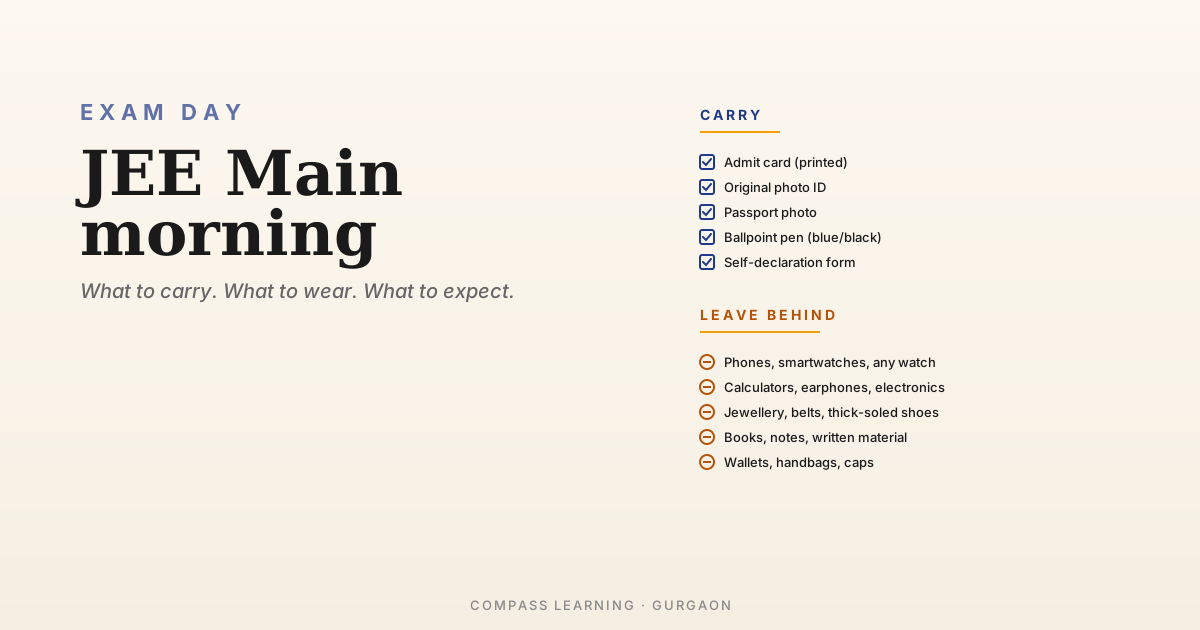
Exam day. JEE Main Exam Day: What to Carry, What to Expect.
Strategy. JEE Main vs JEE Advanced. Why Take Multiple Entrance Exams. A Year-by-Year Calendar from Class XI.
Annual updates. This year's key dates and changes (published each year).
We'll add the links as each article goes live. If you're reading this in early Class XII or earlier, our recommendation is to bookmark this hub and come back whenever you're trying to figure out where you are in the journey.
Have questions about your specific situation?
We're at Ardee City, Sector 52, Gurgaon. Drop by anytime, or give us a call. Always happy to chat through strategy with parents and students — no pitch, no pressure, just a conversation about what makes sense for you.